CONTACT
1
Want to get quotation of concrete batching plant at once? Contact Us. Quick reply is as efficient as our equipment.
+86-15978414719

Oct 13, 2026
A 58m concrete pump is usually considered for high-rise, industrial, bridge, and large commercial work where a smaller boom creates too many hose changes or truck moves. Recent English-language Q&A discussions commonly focus on whether the stated boom length matches real jobsite reach, how much setup room is needed, and whether the pump can maintain output with demanding concrete mixes.
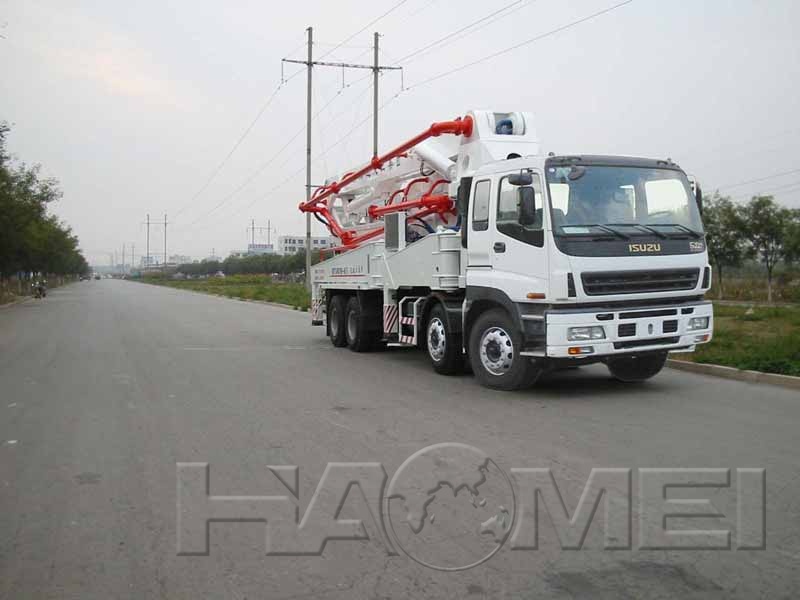
Not exactly in every direction. The 58m figure normally refers to the boom's maximum vertical reach under ideal positioning. Actual placement reach changes with boom articulation, truck location, elevation differences, hose length, and obstacles such as scaffolding, formwork, power lines, and adjacent buildings.
A boom that reaches 58m vertically may provide a shorter horizontal reach when working over a slab edge. If the pump must reach behind a structure, the operator may need to fold the boom into a steeper working shape, reducing the available distance. The final end hose can add useful flexibility, but it should not be treated as a replacement for proper truck positioning.
| Site condition | Effect on usable reach | Practical check before mobilization |
|---|---|---|
| Pump parked close to the structure | More boom length remains available | Confirm outrigger clearance and traffic access |
| Pump parked behind barriers or fencing | Less effective horizontal reach | Measure from the planned pump location, not the road edge |
| High-rise vertical pour | Vertical reach is the main limitation | Compare boom reach with deck height and hose allowance |
| Pouring around columns or cores | Articulation becomes more important | Request the boom folding diagram from the supplier |
For multi-story work, ask for the boom placement chart rather than relying only on the headline number. A 58m unit can be highly effective, but the jobsite layout determines whether that capacity is usable.
This is one of the most important questions because a large boom pump needs a stable footprint. A 58m concrete pump truck often uses multi-stage outriggers that extend well beyond the chassis width. The exact setup dimensions vary by manufacturer, carrier truck, and outrigger design, but a clear, level area on both sides of the vehicle is essential.
Before scheduling a pump, check the width of access roads, gate openings, soil bearing conditions, overhead clearance, and the distance to excavations. Outriggers must not be set near unsupported trench edges, soft backfill, utility chambers, or suspended slabs unless a qualified site engineer confirms the area can carry the load.
A supplier should provide the following information before the first pour:
Overall transport length, width, height, and gross vehicle weight.
Full and partial outrigger spread dimensions.
Required ground bearing pressure or outrigger load data.
Boom clearance envelope and overhead hazard requirements.
Recommended timber mats or engineered outrigger pads.
A large Concrete Pump Truck can reduce repositioning on wide projects, but only when the setup zone is planned before reinforcing steel, site fencing, and material storage restrict access.
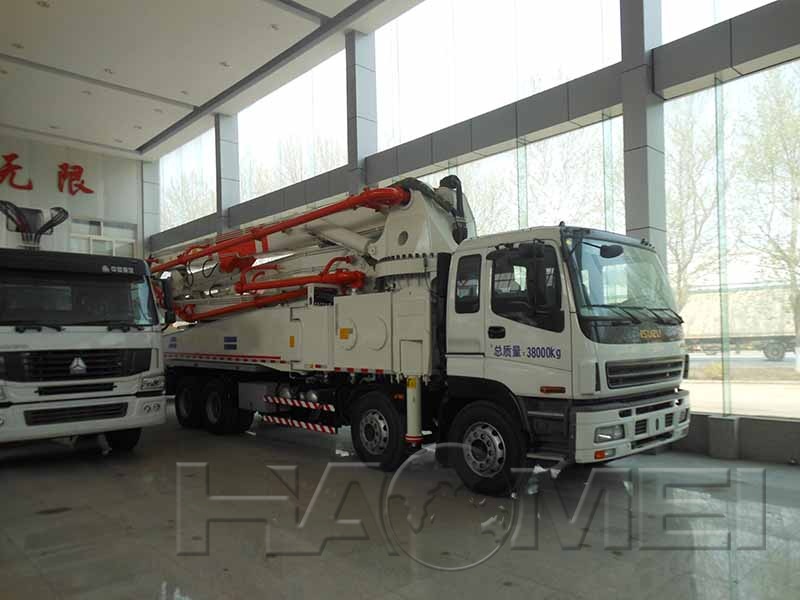
Boom length does not automatically determine pumping output. A 58m concrete pump may have a high-capacity pumping system, but real hourly volume depends on the concrete mix, pipeline condition, hopper charging rate, operator technique, and delivery-truck scheduling.
Manufacturers may publish theoretical output figures that are higher than jobsite production. The actual rate can fall when the mix has poor pumpability, aggregate grading is inconsistent, slump is too low, the line is heavily worn, or concrete trucks arrive with large gaps. Long horizontal runs, steep elevation, and frequent boom movement also add resistance and reduce efficiency.
For planning, separate the pump's maximum rated output from the required average placing rate. A 58m unit may be selected because it can cover the work area, while the batching plant and delivery fleet determine whether enough concrete reaches the hopper continuously.
Ask the supplier about cylinder diameter, stroke rate, maximum concrete pressure, recommended aggregate size, and whether the installed pipeline is suitable for your proposed mix. For high-strength or low-slump concrete, arrange a trial pour when possible. That is especially valuable for core walls, dense reinforcement, and long-duration raft pours.
A 58m boom pump is a heavy, long vehicle and may face route restrictions that smaller equipment avoids. Transport planning can involve bridge weight limits, axle-load rules, turning radius limitations, permit requirements, site-entry timing, and road-width constraints. In dense urban areas, a pump may need an early-morning delivery window or traffic management support.
Operating cost is also broader than fuel consumption. Consider skilled operator availability, routine boom inspection, hydraulic maintenance, wear parts, insurance, tire replacement, cleaning labor, and downtime exposure. Larger machines can bring strong productivity on major pours, but they can be uneconomical when used for scattered, low-volume work with frequent relocations.
A 58m model is generally most suitable when the project has enough pour volume and reach demand to offset its higher operating commitment. For projects with constrained access but substantial reach needs, comparing it with a 52m Truck-Mounted Concrete Pump can reveal whether the extra boom length provides a measurable site advantage.
Start with the chassis and boom as one working system. Confirm the truck engine emissions specification, transmission, axle configuration, local service support, spare-parts availability, and legal road registration requirements in the intended operating region. A high-performance pump package is less valuable if local technicians cannot access diagnostic tools or common hydraulic components quickly.
Inspect the boom steelwork, weld quality, boom-cylinder mounting points, pipeline routing, hopper design, agitator system, remote-control functions, lubrication points, and emergency-stop layout. For the pumping system, compare concrete pressure, theoretical output, S-valve or equivalent valve construction, wear plate materials, cutting ring design, and ease of access for routine replacement.
Ask for documented load calculations, stability information, maintenance intervals, factory testing records, warranty scope, and operator training details. A factory inspection can also reveal practical details that brochures do not show, such as cabinet sealing, hose storage, access step quality, and whether daily cleaning points are easy to reach after a long pour.
A 58m concrete pump performs best when its boom geometry, pumping specification, carrier configuration, and service arrangement are matched to the projects it will serve.
Original source: https://www.concretebatchplanthm.com/a/58m-concrete-pump.html
Tags: 58m concrete pump 58m concrete boom pump concrete pump truck boom pump output