CONTACT
1
Want to get quotation of concrete batching plant at once? Contact Us. Quick reply is as efficient as our equipment.
+86-15978414719

Sep 29, 2026
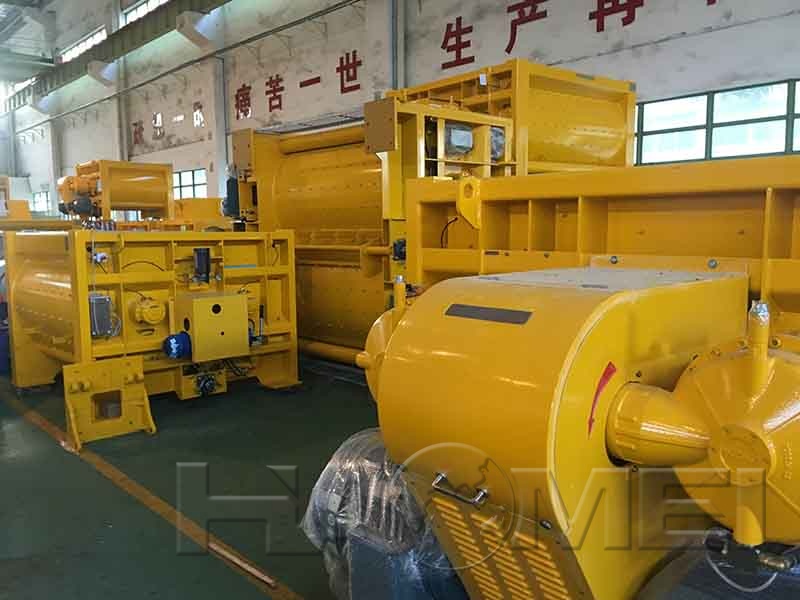
Recent English-language equipment discussions commonly focus on output consistency, maintenance cost, and whether a twin shaft paddle mixer is suitable for demanding concrete formulations. These are practical concerns because the mixer often determines whether a batching plant can maintain its planned production rhythm. A twin shaft design uses two horizontal shafts with paddles that create intersecting mixing zones, helping aggregate, cement, water, and admixtures move through the full mixing chamber rather than simply rotating around one central axis.
| Question area | What to evaluate | Why it matters |
|---|---|---|
| Batch capacity | Compacted concrete output per batch | Prevents production estimates based only on theoretical volume |
| Material type | Aggregate size, moisture, fibers, admixtures | Determines paddle arrangement and liner wear rate |
| Discharge speed | Gate design and discharge time | Affects truck loading and the next batching cycle |
| Service access | Inspection doors, lubrication, wear-part access | Reduces time spent on routine maintenance |
| Power demand | Motor rating, voltage, starting method | Helps match the mixer to the available site electrical supply |
This is one of the most repeated questions from operators comparing mixer types for a new plant. The answer depends less on the mixer label and more on the concrete recipe and required output. A twin shaft paddle mixer is usually preferred for commercial ready-mix concrete, precast work, and low-slump mixes because the counter-rotating shafts generate strong mixing turbulence. This action breaks up cement-rich pockets and moves coarse aggregate through the center of the chamber.
Drum mixers remain practical for smaller, less demanding applications, especially where mobility and simple operation matter more than fast cycle times. Pan and planetary units can be strong options for specialty products, including colored concrete, dry cast products, and certain precast recipes. However, for general high-volume concrete production with 20 mm to 40 mm aggregate, a twin shaft machine often offers a useful balance of mixing intensity, batch size, and discharge speed.
When comparing models, ask for a demonstration using a mix close to your actual design. A mixer can look efficient while running wet mortar but behave very differently with a low water-cement ratio, angular aggregate, or high powder content.
Do not select capacity only from the number printed in a model name. Mixer figures may refer to charging volume, compacted output, or theoretical volume, and these are not interchangeable. For example, a unit with a 1,000-liter charging volume may produce roughly 0.75 cubic meters to 1 cubic meter of compacted concrete per batch, depending on the material and manufacturer configuration.
Use the planned hourly output to work backward from the real batch cycle. Include loading, mixing, discharge, and the short delay before the next batch starts. If a plant needs 60 cubic meters per hour and the practical batch cycle is 75 seconds, the mixer and feeding system must support that production level without operating continuously at the maximum fill level.
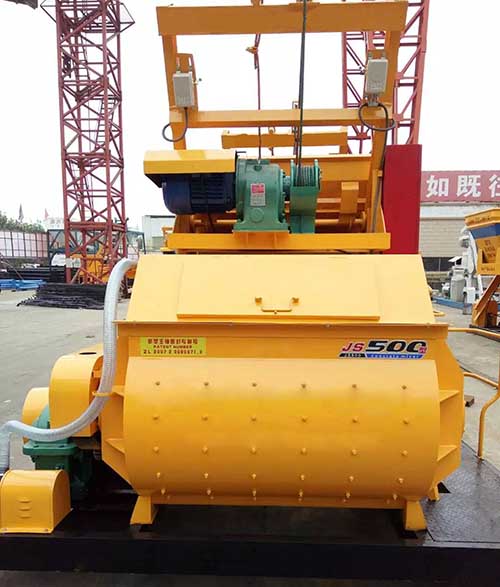
For smaller plant layouts, the JS500 Twin Shaft Concrete Mixer can fit moderate-output applications where transport, installation space, and lower initial capacity are priorities. Larger production schedules need additional room for demand peaks, truck loading delays, and moisture adjustments.
In many cases, yes, but the purchase specification must match the material. Dry and high-strength concrete has greater internal resistance during mixing. Fiber-reinforced concrete can introduce another challenge: fibers may ball together if they are added too quickly or dropped into an already dense mass of aggregate and cement.
For these materials, check the motor power, gearbox torque reserve, paddle geometry, shaft speed, and the supplier's recommended loading sequence. A practical sequence may add part of the aggregate first, then binder materials, followed by water and admixtures. Fibers generally need controlled dosing over part of the mixing cycle rather than a single rapid addition.
Ask whether the mixer has adjustable paddles and replaceable wear liners. Adjustable paddle angles allow the mixing action to be tuned as materials, moisture conditions, or recipe demands change. This is especially valuable where one plant produces both standard structural concrete and low-slump precast mixes.
The highest-maintenance items are usually not the main motors. They are the components exposed directly to abrasive aggregate and cement slurry: paddles, arms, liners, shaft seals, discharge-gate seals, and lubrication points. Maintenance cost is closely related to aggregate hardness, batch frequency, cleaning habits, and whether the machine is routinely overfilled.
A well-specified unit should provide accessible inspection doors, durable liner plates, centralized lubrication where appropriate, and clear adjustment access for paddle clearance. It is sensible to request a wear-parts list before ordering. The list should identify the expected replacement items, material grades, typical service intervals, and whether parts can be changed individually instead of as a complete assembly.
A mixer that is inexpensive initially can become costly if replacement paddles are proprietary, seals are difficult to obtain, or service work requires removing major components. For operations expecting continuous production, a Sicoma Twin Shaft Mixer configuration may be considered when durable components, established service procedures, and consistent high-volume mixing are required.
Installation planning starts with the foundation and electrical system. The mixer frame must sit level and be secured to a structure designed for operating vibration, material load, and discharge forces. Electrical planning should confirm voltage, frequency, motor starting requirements, control-panel protection, and emergency-stop integration.
Also examine the entire material path, not just the mixer. Aggregate bins, conveyors, cement screws, water dosing, admixture lines, and skip hoists must deliver materials at a pace that supports the intended batch cycle. If the mixer discharges in 15 seconds but the aggregate weighing system needs 70 seconds to prepare the next load, the plant output will be limited by weighing rather than mixing.
During commissioning, run several trial batches and record mixing time, slump consistency, discharge time, motor current, and residual material left in the chamber. These observations provide a useful baseline for future maintenance and help operators recognize changes before they affect concrete quality.
Original source: https://www.concretebatchplanthm.com/a/twin-shaft-paddle-mixer.html
Tags: twin shaft paddle mixer twin shaft concrete mixer concrete mixing equipment
Prev: HZS50 Concrete Batching Plant VS HZS60 Concrete Batching Plant