CONTACT
1
Want to get quotation of concrete batching plant at once? Contact Us. Quick reply is as efficient as our equipment.
+86-15978414719

Oct 09, 2026
A listed boom length is not the same as the usable placing area. Concrete pump truck reach depends on boom geometry, truck position, outrigger footprint, elevation changes, hose length, and obstructions. Selecting solely by a 37 m, 45 m, or 52 m class can leave part of a slab inaccessible or create an unsafe setup.
For each project, start with a site drawing and mark the truck's possible setup points. Then test whether the boom can place concrete at the furthest point without stretching the end hose, crossing prohibited areas, or operating close to overhead power lines.
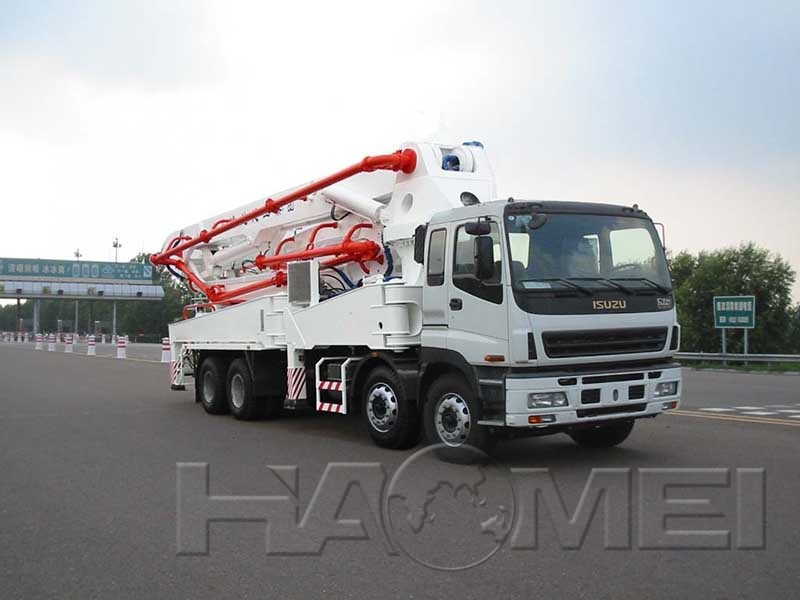
Manufacturers publish a boom's nominal vertical reach, horizontal reach, and depth reach. These values are useful comparisons, but they are measured under defined manufacturer conditions. They do not replace a jobsite placement plan.
Horizontal reach is normally the most important dimension for slabs, foundations, and large floor plates. Vertical reach matters for elevated decks, walls, and high-rise work. Depth reach matters for basements, pits, and below-grade structures.
Use this pre-selection checklist:
| Boom class | Typical best-fit work | Main reach limitation to check | Setup consideration |
|---|---|---|---|
| 28 m to 32 m | Houses, low-rise work, confined urban sites | Limited coverage across wide slabs | Often easier to position, but still needs full stabilizer support |
| 36 m to 42 m | Commercial slabs, warehouses, mid-rise work | May require relocation on deep floor plates | Compare front and rear outrigger spread |
| 43 m to 52 m | Large slabs, elevated decks, larger projects | Greater boom reach can increase setup space and transport constraints | Ground bearing capacity becomes more critical |
| 56 m and above | Major infrastructure, high-rise, large industrial sites | Site access, traffic control, and restricted setup zones | Requires detailed logistics and engineered support planning |
A 37 Meters Concrete Pump Truck For Sale can suit projects where access roads and setup areas are tight, while a larger boom may reduce truck repositioning on broad commercial slabs. The correct choice depends on the measured placement envelope, not the maximum stated boom length.
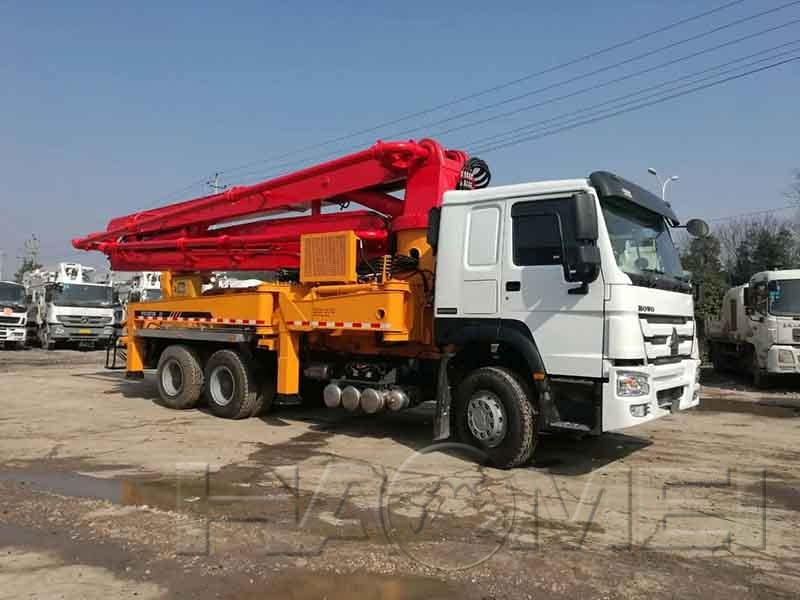
A long boom does not add value if outriggers cannot be fully deployed. Outrigger span can exceed the apparent width of the truck substantially. Request the manufacturer's support dimensions for each outrigger mode, including one-sided or reduced-spread modes where available. Reduced-spread operation may also affect the permitted working range, so follow the load and stability information supplied with the machine.
Before setup, the competent site team should assess these conditions:
| Site condition | Risk | Practical control |
|---|---|---|
| Backfilled ground or soft shoulders | Settlement or overturning | Use suitable outrigger pads and verify ground bearing capacity |
| Excavation edge | Collapse or loss of support | Keep equipment away from the edge based on the excavation plan and soil assessment |
| Suspended slabs or basement decks | Structural overload | Obtain written confirmation of allowable loads from the responsible engineer |
| Overhead lines | Electrocution or arcing | Identify voltage, establish clearances, and coordinate with the utility owner |
| Public road setup | Vehicle strike and blocked emergency access | Use a traffic management plan and approved exclusion zone |
In the United States, OSHA 29 CFR 1926.702 addresses concrete construction, including the requirement that no construction loads be placed on a concrete structure unless the employer determines it can support the loads. OSHA's excavation requirements at 29 CFR 1926 Subpart P also apply where setup is near trenches or excavations. Local rules, utility-owner requirements, and the pump manufacturer's operating manual may impose additional controls.
Pump operators should establish a restricted area around the boom and delivery hose. The crew must never stand under the boom, place hands near pinch points, or open a pipeline while pressure remains. The American Concrete Pumping Association publishes safety resources that emphasize communication, pipeline inspection, proper stabilization, and controlled line cleaning.
Reach alone does not determine production. A boom truck must also match the concrete mix, line diameter, pumping pressure, hopper capacity, and planned delivery rate. High-strength mixes, harsh aggregates, long pipelines, and vertical pumping increase resistance. Review the manufacturer's pump performance curves rather than assuming maximum theoretical output will be achieved on every pour.
For a 45 m class machine, compare the boom diagram, pump cell output, maximum pressure, and chassis axle configuration. A 45 Meter Concrete Boom Truck is often considered for projects needing broad slab coverage, but its value depends on whether the jobsite has enough access width, setup area, and concrete supply capacity to keep it productive.
Use this investment screen before choosing a machine:
| Decision factor | What to request or calculate |
|---|---|
| Utilization | Expected pumping hours, pour days, seasonal demand, and standby time |
| Revenue fit | Local demand by boom class, customer project types, and travel radius |
| Transport | Gross vehicle weight, axle loads, permits, road restrictions, and site access routes |
| Operating cost | Fuel, wear parts, hydraulic oil, lubrication, tires, inspections, insurance, and operator labor |
| Service support | Parts availability, technician response time, remote diagnostics, and warranty terms |
| Residual value | Brand support, maintenance history, hours, boom condition, and local resale demand |
Do not compare purchase price alone. A larger unit may reduce setups and labor on suitable sites, but it can bring higher capital cost, transport constraints, insurance exposure, and maintenance expense. Ask suppliers for a written specification covering boom dimensions, outrigger spread, pump output, pressure, hopper volume, chassis details, and warranty coverage.
Digital fleet tools can improve reach planning and operating control. Telematics data such as engine hours, pumping hours, fuel use, fault codes, lubrication alerts, and location history help managers schedule preventive maintenance and identify underused equipment. Pair those records with pour reports that document concrete volume, setup time, pump time, downtime cause, and repositioning events. This creates a practical record for deciding whether the next machine should have more reach, higher output, or a more compact setup footprint.
Original source: https://www.concretebatchplanthm.com/a/concrete-pump-truck-reach.html
Tags: Concrete Pump Truck Reach Concrete Boom Pump
Prev: Where to Find A Reliable Diesel Concrete Mixer Pump Manufacturer