CONTACT
1
Want to get quotation of concrete batching plant at once? Contact Us. Quick reply is as efficient as our equipment.
+86-15978414719

Nov 03, 2026
A small concrete pump for sale can be a practical choice for residential foundations, sidewalks, retaining walls, rural builds, and confined commercial jobs. However, compact does not automatically mean suitable for every pour. The most useful purchase questions focus on the material being pumped, delivery distance, daily output, access limitations, and local service capability.
The questions below reflect common English-language Q&A themes from contractors and first-time equipment owners researching compact pumping equipment.
| Purchase factor | What to check before ordering | Why it matters |
|---|---|---|
| Pump output | Rated m3/h or yd3/h, plus real working output | Prevents selecting a unit that slows the pour |
| Pumping pressure | Maximum concrete pressure and vertical capability | Affects hose length, elevation, and difficult mixes |
| Aggregate size | Maximum permitted aggregate diameter | Reduces clogging and wear risk |
| Power source | Diesel engine, electric motor, or truck-mounted PTO | Determines operating cost and site suitability |
| Service support | Parts stock, manuals, warranty, and technician access | Protects uptime after delivery |
The right size depends less on the total concrete volume and more on the required placing rate and hose route. For a modest driveway or a small residential slab, a compact trailer pump with a realistic working output of 20 to 40 m3/h is often enough when the ready-mix truck can feed the hopper consistently. A larger rated output is not always useful if the crew can only place and finish concrete at a slower pace.
Measure the longest hose path from the pump location to the farthest pour point. Include bends, elevation changes, and the extra hose needed for safe positioning. A pump with adequate pressure is more valuable than one with a high theoretical output when concrete must travel uphill or through multiple 90-degree elbows.
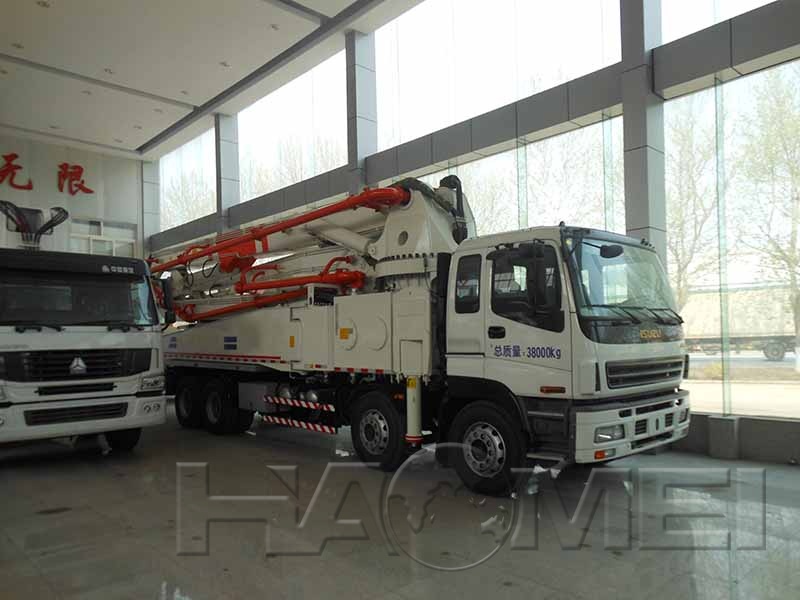
If the project regularly needs long reach without placing hoses across the site, compare a compact trailer unit with a Concrete Pump Truck. Truck-mounted equipment can reduce hose handling, but it also needs road access, outriggers, and enough setup room.
Usually, yes, but the mix must match the pump specification. The main checks are maximum aggregate size, slump range, cement content, and the presence of fibers or admixtures. A compact concrete pump may perform well with conventional pea-gravel or small aggregate mixes, while a harsh, low-slump mix with oversized stone can cause blockages, high line pressure, and accelerated wear.
Ask the concrete supplier for the proposed mix ticket before confirming the pump model. Then compare the aggregate specification with the manufacturer's stated maximum aggregate size. Do not assume that a mix suitable for a chute discharge is automatically suitable for pumping.
A practical field rule is to keep the pipeline clean, use the correct priming slurry, and avoid stopping the pump for long periods with concrete sitting inside the delivery line. For fiber-reinforced concrete, obtain written confirmation that the pump and valve system are designed for that material.
The advertised machine price is only one part of the ownership cost. New compact pumps vary by output capacity, engine brand, hydraulic system, hopper design, remote-control configuration, and included pipeline. A lower-priced pump may arrive with limited hoses, no spare wear parts, or an engine configuration that is difficult to support locally.
Use this cost checklist when comparing quotations:
| Cost item | Questions to ask |
|---|---|
| Machine price | Does it include the engine, remote, hopper grate, and standard tools? |
| Delivery | Are freight, inland transport, insurance, and unloading included? |
| Pipeline package | How many meters of hose or pipe are supplied, and what diameter is it? |
| Commissioning | Is startup testing included, and who trains the operator? |
| Wear parts | What are the prices for pistons, wear plates, cutting rings, and pipe clamps? |
| Warranty | What components are covered, for how long, and under what operating conditions? |
A well-equipped pump with accessible parts can deliver better value than a cheaper unit that cannot return to work quickly after a wear-part replacement.
A trailer-mounted concrete pump is often the better fit when access is narrow, the pour area is behind a building, or the job needs flexible hose routing. It can be positioned near the road or beside the concrete truck, then deliver material through hoses to the placement area. Its tradeoff is labor: the crew must move, support, and clean the hose system.
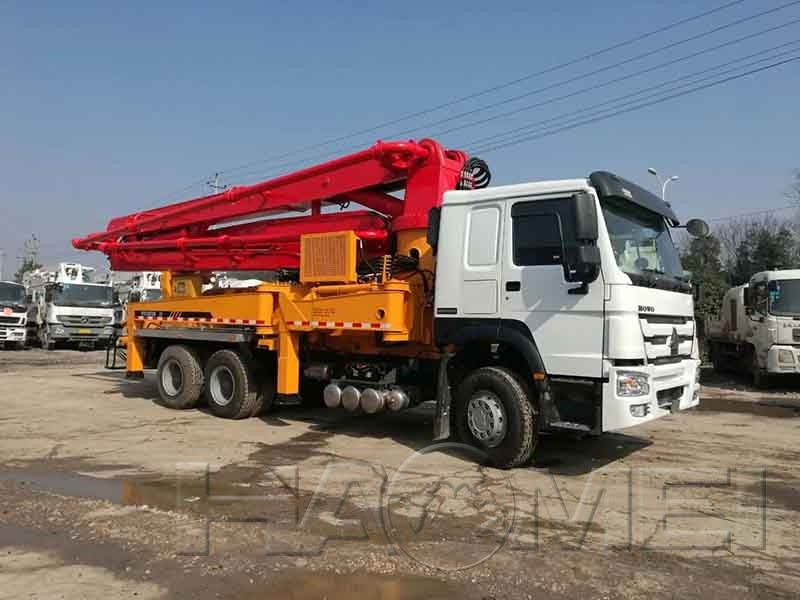
A boom pump is faster for elevated work, broad slabs, and jobs where placing hoses would obstruct traffic or create trip hazards. It also requires more clearance and a stable setup area for outriggers. A 37-meter boom is generally beyond the needs of very small pours, but it can be relevant for contractors expanding into larger residential or light-commercial work. In that case, assess the specifications of a 37 Meters Concrete Pump Truck For Sale against the actual access and reach requirements of the work.
For compact sites, draw a simple layout showing truck access, pump position, hose route, washout area, power lines, gates, and pedestrian separation before choosing either configuration.
Daily cleaning is the most important maintenance task. Concrete left in the hopper, valve area, delivery pipes, or hoses can harden and create expensive downtime. After each shift, operators should wash the hopper, lubricate moving points, inspect hydraulic-fluid levels, and clean the delivery system using the approved procedure.
Weekly inspections should include hose couplings, clamps, wear plates, cutting rings, agitator components, tire condition, engine belts, filters, and hydraulic connections. Keep a record of operating hours and replace wear parts based on measured condition rather than waiting for a failure during a pour.
Before placing an order, ask the supplier for an English operation manual, hydraulic schematic, spare-parts list, recommended maintenance intervals, and a list of consumable parts supplied with the machine. These documents are especially important for a first pump because they help an operator identify normal wear before it becomes a pumping problem.
Original source: https://www.concretebatchplanthm.com/a/small-concrete-pump-for-sale.html
Tags: small concrete pump for sale compact concrete pump trailer concrete pump concrete pumping equipment
Prev: How to Choose the Right Concrete Mixer Pump for Small and Medium Construction Projects