CONTACT
1
Want to get quotation of concrete batching plant at once? Contact Us. Quick reply is as efficient as our equipment.
+86-15978414719

Feb 04, 2026
In infrastructure construction such as highways, railways, and municipal works, stabilized soil mixing plants are the "core equipment" for ensuring the quality of base layer construction. What constitutes a qualified stabilized soil mixing plant?
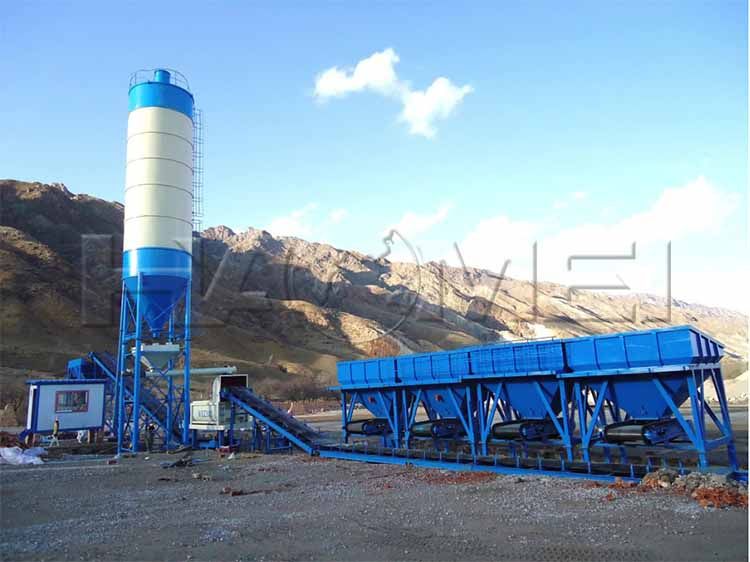
The primary criterion for judging the quality of a mixing plant is whether its actual output matches the construction needs and remains consistently stable. A qualified stabilized soil mixing plant must meet the requirement that "nominal output ≠ peak output," meaning that after continuous operation for more than 8 hours, the actual output should remain above 90% of the nominal value without significant fluctuations.
This relies on a reasonable equipment layout (such as the adaptability of aggregate bins and conveyor belts), sufficient power reserves, and a smooth material conveying system.
The mix proportions of stabilized soil need to be flexibly adjusted according to engineering design requirements, geological conditions, and material properties. A qualified mixing plant must possess strong formula adaptation capabilities. On the one hand, it supports various material ratios (such as cement-stabilized soil, lime-stabilized soil, and lime-fly ash-stabilized soil), with ample formula storage for quick retrieval of historical formulas, reducing repeated debugging time.
On the other hand, facing different batches and raw materials with different characteristics (such as variations in aggregate gradation and cement grade), it can ensure accurate proportions through convenient parameter adjustments, preventing substandard strength and stiffness of stabilized soil due to poor formula compatibility.
Furthermore, a high-quality mixing plant's control system has a formula verification function. When the input proportion exceeds the reasonable range, it automatically alarms, preventing human error and ensuring formula accuracy from the source.
The moisture content and aggregate gradation of stabilized soil directly determine its compaction, strength, and durability, and are also the most problematic aspects during construction. A qualified stabilized soil mixing plant must have precise moisture content and gradation control capabilities.
In terms of moisture content control, it's essential not only to accurately measure the total amount of water added but also to have real-time adjustment capabilities. This involves monitoring the aggregate moisture content in real time using a moisture meter and automatically compensating for the amount of water added, preventing the stabilized soil from becoming too dry and loose, or too wet and segregating, due to uneven aggregate moisture content.
For gradation control, a multi-bin aggregate storage system is required, with each bin corresponding to aggregates of different sizes. Accurate measurement of the amount of each aggregate size ensures that the aggregate gradation meets design standards, laying the foundation for the strength of the stabilized soil.
The core of accurate formulation implementation lies in the metering accuracy of aggregates, powders, and water. A qualified stabilized soil mixing plant must adopt metering methods that comply with national standards, and the metering error must be controlled within allowable limits (typically, aggregate metering error ≤ ±2%, powder ≤ ±1%, water ≤ ±1%).
Aggregate metering primarily utilizes belt scales or cumulative scales, requiring anti-interference capabilities to prevent metering deviations caused by belt vibration and material accumulation.
Powder metering (cement, lime, fly ash, etc.) necessitates sealed metering chambers to minimize dust leakage, while high-precision sensors provide real-time weight feedback to ensure accurate measurement.
Water metering employs electromagnetic flow meters or mass flow meters, combined with variable frequency pumps to regulate water flow and achieve precise water replenishment.
Furthermore, the metering system must have a periodic calibration function for convenient daily verification by users, ensuring long-term stable metering accuracy.
The mixing blades of our soil cement plant are made of high-strength, wear-resistant alloy material to withstand aggregate wear and extend replacement cycles. The reducer uses a hardened gear reducer, offering strong load-bearing capacity, stable operation, and reduced transmission failures. High-precision sensors are selected from imported or top-tier domestic brands, ensuring accurate and reliable metering data. Simultaneously, key components must possess versatility to facilitate future maintenance and replacement, reducing spare parts procurement costs and downtime. If you like to learn more about our stabilized soil mixing plant, welcome to contact us directly.
Original source: https://www.concretebatchplanthm.com/a/what-is-a-qualified-stabilized-soil-mixing-plant.html
Tags: stabilized soil mixing plant