CONTACT
1
Want to get quotation of concrete batching plant at once? Contact Us. Quick reply is as efficient as our equipment.
+86-15978414719

Jan 04, 2026
In 2025, the global concrete mixer industry experienced steady growth, with the market size projected to reach 40.8 billion yuan. Driven by expanded global infrastructure investment, accelerated urbanization in developing countries, and the "dual-carbon" strategy, the industry is rapidly transforming towards intelligent, energy-saving, and green technologies. Which type of concrete mixer is more popular?
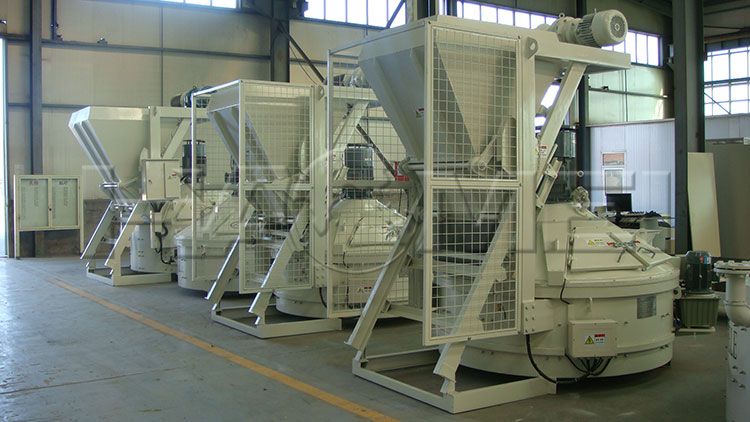
In 2025, the planetary concrete mixer continued to gain popularity in the global high-end market, becoming almost standard equipment, especially in the production of ultra-high performance concrete (UHPC) and the mixing of precision chemical materials. Their core advantage stems from their unique planetary transmission structure. The mixing arms achieve thorough mixing of materials through a combined revolution and rotation trajectory, achieving uniform dispersion of materials throughout the tank within 5 seconds, effectively solving the pain points of traditional models such as fiber clumping and material segregation.
Beyond the construction sector, planetary dispersion mixers are also expanding their application in fine chemical fields such as coatings, inks, and new energy materials globally. With their closed-loop control system and adaptive wall scraping technology, they have become key equipment in pilot-scale and production stages.
At the 2025 China International Concrete Exhibition and the European Construction Machinery Exhibition, high-end mixing plants equipped with vertical shaft planetary mixers were showcased. Leveraging their uniform steel fiber distribution and high mixing efficiency, these plants are creating greater economic benefits for major global projects (such as the Saudi NEOM New City and European green building projects).
Energy saving and high performance are another major highlight of planetary mixers. Compared to traditional equipment, their energy consumption can be reduced by more than 30%, while simultaneously increasing concrete density by 30% through high-strength shear force. This makes them suitable for scenarios with extremely high requirements for material durability, such as global marine engineering, wind turbine towers, and high-end precast components.
Furthermore, vertical shaft laboratory planetary mixers, specially designed for research and development, have become core equipment for formula optimization by global precast component companies and fine chemical companies, thanks to their precise speed control and data traceability.
However, planetary mixers require a high initial investment, and their core market is concentrated in high-end engineering fields in Europe and North America, as well as developed regions in the Asia-Pacific. Purchasing intentions are relatively low in developing countries and small-to-medium-sized projects, and the global market share is still in a steady growth phase.
Twin-shaft mixers (especially horizontal twin-shaft models) will remain a mainstay in large-scale infrastructure projects worldwide by 2025 due to their high efficiency and stability. Their counter-rotating shafts generate strong shear and convection effects, achieving thorough mixing of materials while maintaining high uniformity and shortening mixing time. This makes them particularly suitable for scenarios with stringent requirements for output and quality stability, such as global precast concrete production and large-scale infrastructure projects.
Regional demand is concentrated in the Asia-Pacific and North America regions, which are the core markets for twin shaft concrete mixers. Benefiting from the US$1.2 trillion infrastructure bill in the United States and the high-speed rail construction boom in Southeast Asia, the demand for large-capacity twin-shaft mixers continues to rise.
Durability is one of the core competitive advantages of twin-shaft mixers. Key components utilize special wear-resistant materials (such as graphene wear-resistant liners), extending the service life by 40%-50% compared to traditional models, significantly reducing downtime maintenance costs for batching plants worldwide.
Meanwhile, it boasts exceptional compatibility, capable of handling dry-mix, wet-mix, and specialty concrete. It can also integrate with intelligent batching systems and 5G remote control systems to achieve automated production and real-time operational monitoring, meeting the construction needs of intelligent batching plants worldwide.
However, twin-shaft models also have significant drawbacks: higher energy consumption, with power requirements far exceeding those of drum mixers; more moving parts leading to complex maintenance, requiring skilled technicians for regular inspections; and larger initial investment and footprint. These characteristics make them more suitable for large-scale batching plants, large-scale projects, and companies with strong financial resources. Their penetration rate is relatively low in some small and medium-sized markets in Africa and Latin America.
Global market data shows that drum mixers will remain the most popular model in 2025, projected to account for 36.8% of the global market share. Their core advantages lie in their simple structure, ease of operation, and outstanding cost-effectiveness, making them the mainstream choice for small and medium-sized projects worldwide.
The global drum mixer market exhibits clear regional stratification, with Asia-Pacific, Africa, and Latin America being the core demand areas. Benefiting from smart city construction in India, infrastructure expansion in Vietnam, and the demand for localized construction in Africa, sales of small and medium-sized drum mixers continue to surge.
Drum mixers are suitable for a wide range of scenarios, easily handling small and medium-sized construction sites, rural infrastructure, and decoration projects worldwide where high mixing precision is not required. Their low purchase cost and moderate energy consumption make them the preferred choice for small and medium-sized enterprises and scattered construction projects globally.
Regional application perspectives: In the European market, driven by strict carbon emission policies, the penetration rate of electric drum mixers is rapidly increasing, exceeding 35% by 2025. In emerging markets in the Asia-Pacific region, traditional fuel-fired drum mixers remain the mainstream, while electric models are gradually becoming more widespread. In the African market, cost-effective and economical drum mixers are the most favored.
However, their limitations are also apparent: insufficient mixing uniformity makes them unsuitable for high-end materials such as fiber-reinforced concrete and UHPC; their mixing efficiency is lower than planetary and biaxial mixers, making them unsuitable for large-scale, high-standard projects globally.
In 2025, with the advancement of global green policies, electric and intelligent drum mixers will gradually become more widespread, further consolidating their advantages in the low-to-mid-end market. It is estimated that the global drum mixer market size will climb at a CAGR of 7.9% from 2025 to 2030.
Original source: https://www.concretebatchplanthm.com/a/the-favored-concrete-mixer-type-in-2025.html
Tags: twin shaft concrete mixer
Prev: What Is Concrete Manufacturing Plant Cost
Next: Which Kind of Asphalt Batching Plant Is Suitable for Road Maintenance