CONTACT
1
Want to get quotation of concrete batching plant at once? Contact Us. Quick reply is as efficient as our equipment.
+86-15978414719

Jan 08, 2026
Road maintenance work is characterized by dispersed locations, flexible schedules, and significant variations in project volume. Selecting the right asphalt plant directly impacts construction efficiency, maintenance quality, and cost control. Unlike large-scale infrastructure projects that require large-scale asphalt plants, road maintenance asphalt plants need to balance "precise production capacity" with "scenario adaptability."
So, how should the production capacity of an asphalt plant suitable for road maintenance projects be defined? Based on global industry practice, Haomei Machinery, asphalt batch mix plant supplier, recommends asphalt plants with a daily output of 50-200 tons for this project.
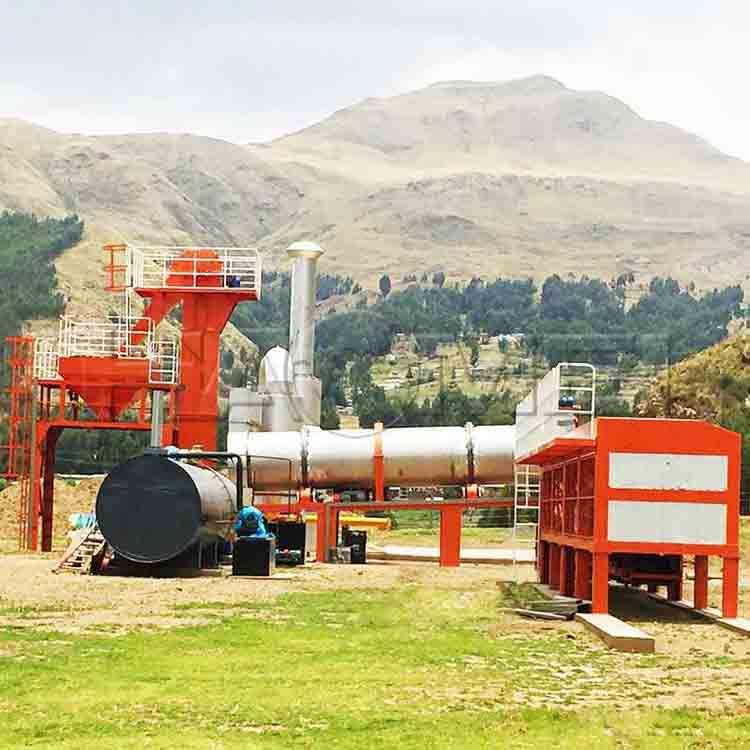
For small-scale maintenance projects such as rural branch roads and roads around communities, a production capacity of 50-100 tons/day is sufficient to meet demand and flexibly handle scattered repair tasks.
For medium-sized road renovation projects such as regional trunk roads and suburban connecting roads, a production capacity of 100-200 tons/day can ensure construction progress and avoid delays due to insufficient production capacity.
When procuring asphalt, it's crucial to analyze factors such as the average annual workload of maintenance projects, the maximum demand for a single construction phase, the construction cycle, and local transportation conditions in advance. Accurate calculation of required production capacity is essential to ensure that asphalt plant output is neither idle nor insufficient, achieving a precise match between capacity and demand.
In various road maintenance scenarios globally, the portable asphalt plant for sale offers significant advantages, even becoming the preferred choice for many international construction companies. Their core advantages lie in three dimensions: flexibility, efficiency, and cost control.
Firstly, they possess strong mobility, adapting to diverse global operating scenarios. Global road maintenance sites are often extremely dispersed, potentially spanning different regions and covering multiple differentiated road sections. Fixed asphalt plants, limited by site and geographical constraints, cannot flexibly relocate with construction sites. Furthermore, long-distance transportation of the asphalt mixture can lead to issues such as temperature drops and segregation, thus affecting construction quality.
Mobile asphalt plants employ a modular design, allowing for disassembly, transportation, and rapid on-site assembly. They require no fixed site and can be deployed directly near construction areas, achieving "wherever repair is needed, the equipment goes." This significantly shortens the transportation distance of asphalt mixtures, ensuring their freshness and performance stability. They are particularly suitable for maintenance scenarios with inconvenient transportation, such as remote rural areas, mountainous roads, and transnational highways. This advantage has been fully validated in numerous UN-aided road projects in underdeveloped regions.
Secondly, they offer rapid production, improving emergency response efficiency. Road maintenance often involves emergency repair tasks, such as repairing road damage and potholes after heavy rain or snow. Waiting for fixed asphalt plants to produce and transport mixtures may cause delays in optimal repair times, exacerbating road damage.
Mobile asphalt plants are easy to disassemble and transport. Upon arrival, they require only simple adjustments before production can begin. Assembly and production can typically be completed within 2-4 hours, rapidly responding to emergency maintenance needs and minimizing disruption to road traffic.
Finally, they offer lower costs, reducing operational pressure. On the one hand, mobile asphalt plants eliminate the need for fixed factory buildings and infrastructure, saving on site rental and construction costs, resulting in lower initial investment costs compared to fixed asphalt plants.
On the other hand, their convenient transportation and assembly allow for flexible deployment according to maintenance project schedules, preventing long-term equipment idleness and reducing fuel consumption and losses during asphalt mixture transportation, further lowering operating costs.
Furthermore, mobile asphalt plants are relatively easier to maintain, and subsequent maintenance costs are more controllable, better meeting the cost-conscious requirements of road maintenance projects.
Of course, besides output and mobility, the procurement of asphalt plants for road maintenance also requires consideration of factors such as the equipment's intelligence level, environmental performance, and ease of operation. However, precise matching of output is fundamental, and the advantage of mobility is core to adapting to maintenance scenarios.
Original source: https://www.concretebatchplanthm.com/a/which-kind-of-asphalt-batching-plant-is-suitable-for-road-maintenance.html
Tags: mobile asphalt plant