CONTACT
1
Want to get quotation of concrete batching plant at once? Contact Us. Quick reply is as efficient as our equipment.
+86-15978414719

Apr 30, 2026
In infrastructure construction and commercial concrete production, concrete batching plant stationary type is a core equipment, and its selection directly determines construction efficiency, concrete quality, and long-term operating costs.
Many purchasers blindly pursue "high capacity" and "low price," often ending up in a predicament of insufficient compatibility, frequent malfunctions, and soaring maintenance costs. Based on years of experience, Haomei Machinery offers the following selection suggestions to help customers make informed choices.
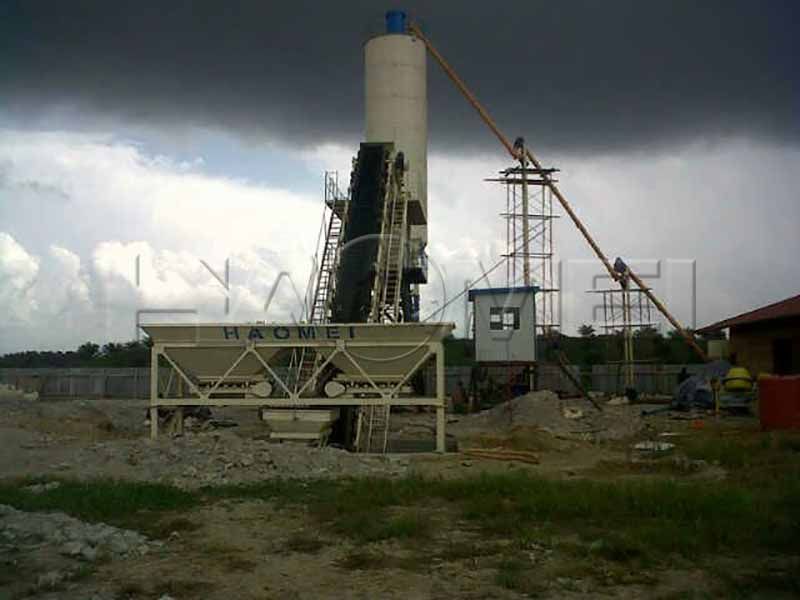
The core of selection is to understand your own construction needs, avoiding "using oversized materials" or "insufficient capacity." Focus on clarifying three key points:
The required mixing plant specifications can be calculated using the formula X=M÷(T×H×K) (X is the specifications, M is the total workload, T is the number of pouring days, H is the daily working hours, and K is the utilization coefficient, ranging from 0.7 to 0.9). Simultaneously, consider the method of transporting finished concrete and the volume of the transport vehicles.
Different projects have significantly different requirements. For example, water conservancy projects require specialized hydraulic mixing units, while high-speed rail projects require high-performance specialized high-speed rail mixing units. The batching station and storage silos should be selected based on the type of material.
For large-volume, high-quality pours without reinforcement equipment, two small-scale mixing plants or a main and auxiliary configuration can be used. For scattered but relatively close construction sites, multi-site centralized mixing can be used to improve equipment utilization.
Core configurations directly affect production efficiency and concrete quality. Focus on three core components to avoid the trap of "falsely labeled parameters":
Prioritize forced-drive mixing units (the mainstream type). Twin-shaft concrete mixers have a wide range of applications and can mix various types of concrete, providing uniform and efficient mixing. Vertical-shaft forced-drive units are suitable for high-grade and special concretes, but have higher energy consumption and maintenance costs. Gravity-fed mixing units have low efficiency and mediocre performance and are gradually being phased out.
The batching accuracy of standard equipment must be controlled within ±2%. It must be confirmed that cement, sand, water, and admixtures all have independent metering devices to ensure the concrete strength meets standards.
Belt conveyors are suitable for medium to large-scale, high-capacity projects, offering fast feeding and stable operation. An 800mm diameter conveyor has a capacity of 450-650 tons/hour, while a 1000mm diameter conveyor can reach up to 1000 tons/hour. Hopper conveyors are compact, low-cost, and suitable for projects with limited space and moderate demand.
Relocating a stationary concrete plant after installation is difficult and costly. Therefore, it is essential to confirm site conditions and compliance requirements in advance to avoid rework:
Reserve sufficient space according to the equipment model (e.g., 600-800 square meters of hardened site for the HZS90 model, 800-1000 square meters for the HZS180 model). Plan the locations of aggregate storage yards, cement silos, and laboratories, and reserve transportation channels and maintenance space. Simultaneously, confirm that the geological conditions meet the requirements for equipment foundation pouring to prevent later settlement.
Regarding environmental protection, fully enclosed batching plants must be selected in urban areas and key regions, equipped with pulse dust collectors, sand and gravel separators, and other environmental protection equipment, meeting local emission standards. Regarding electricity, confirm that the site has sufficient power capacity (e.g., 200-250 kilowatts for the HZS120 new ready mix plants for sale). If power is insufficient, a backup diesel generator set must be planned in advance.
Purchasers should not only focus on the unit price of equipment but also calculate the entire lifecycle cost, paying particular attention to the following three points:
Avoid blindly pursuing low prices. While equipment assembled by small manufacturers using OEM brands may be cheaper, its precision and stability are poor, leading to frequent malfunctions later on.
The core costs are energy consumption and replacement of wear parts. High-quality equipment can consume 8%-10% less energy than the industry average and extend the lifespan of wear parts by about 15%, significantly reducing long-term expenses.
Understand the prices and replacement cycles of wear parts (mixing blades, liners, etc.) in advance. Choose equipment with universally applicable wear parts, easy procurement, and a structure that facilitates maintenance to minimize downtime.
Stabilizing a stationary mixing plant has a lifespan exceeding 10 years. Manufacturer strength and after-sales service are crucial. Focus on the following three points:
Prioritize manufacturers that have passed ISO9001 quality management system and environmental management system certifications. Confirm that they possess mature production processes (such as laser cutting) with a processing accuracy of ±0.05mm to ensure equipment stability.
A 24-hour response mechanism is required, along with services such as installation, commissioning, inspection, and operator training.
Refer to similar project case studies from the manufacturer and consult with peer users to understand equipment failure rates and manufacturer response speed.
Efficient equipment operation relies on professional personnel. Personnel suitability must be considered during purchase: Small mixing plants have simple structures and require fewer operators; large mixing plants have complex structures and high levels of automation, requiring specialized central control, batching, and maintenance personnel (e.g., the HZS180 model requires 12-15 operators).
When purchasing, confirm whether the manufacturer provides free operator training. Based on your own personnel configuration, choose equipment with a suitable level of automation to avoid inefficiencies or safety hazards due to insufficient personnel expertise.
Original source: https://www.concretebatchplanthm.com/a/what-to-check-before-buying-a-stationary-batching-plant.html
Tags: stationary concrete plant