CONTACT
1
Want to get quotation of concrete batching plant at once? Contact Us. Quick reply is as efficient as our equipment.
+86-15978414719

May 12, 2026
A stabilized soil mixing station produces cement-treated base, lime-treated soil, and other bound granular layers for highways, airports, yards, and industrial platforms. The purchase decision is not only about tons per hour. It affects pavement quality, binder waste, site permits, dust exposure, trucking balance, and future resale value.
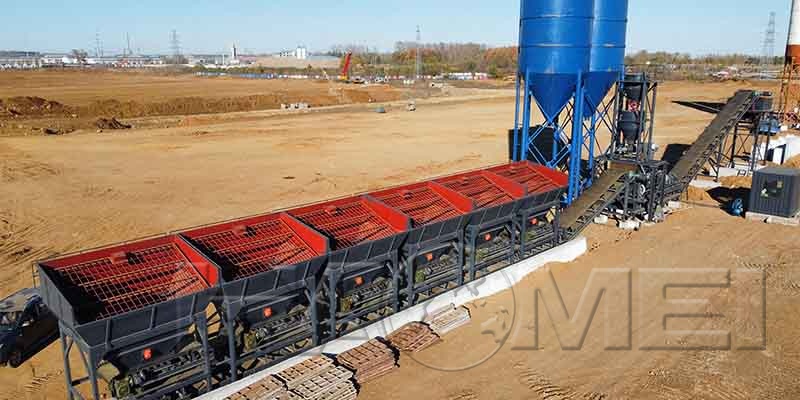
This equipment continuously proportions aggregate or soil, cement, lime, fly ash, water, and sometimes additives. The blended material is discharged to trucks or conveyors for paving, grading, and compaction. It is different from an asphalt plant, which dries aggregate and mixes it with bitumen at elevated temperature. If your project also includes wearing-course production, coordinate base-layer output with an Asphalt Mixing Plant so trucks, pavers, and rollers are not waiting on each other.
Use a central mixing setup when the project needs controlled binder dosing, traceable production records, and steady output over many shifts. In-place stabilization can be cheaper for small rural sections, but central mixing usually gives better uniformity when specifications are strict or when imported aggregate is used.
Check these work conditions before you request quotations:
Laboratory mix design should be done before equipment sizing. In the United States, ASTM D558 is commonly used for soil-cement moisture-density relations, ASTM D1632 for making and curing specimens, and ASTM D1633 for compressive strength testing. Many highway agencies also use AASHTO methods such as T 134 for soil-cement moisture-density testing. Always follow the project specification first, because strength and cement content limits are contract requirements.
A plant rated at 600 t/h will not deliver 600 usable tons every hour if trucks, loaders, water supply, or cement unloading cannot keep up. Size the whole production chain, not just the mixer.
| Decision item | What to verify | Practical target |
|---|---|---|
| Rated capacity | Continuous output at design moisture | 20% to 30% above average hourly demand |
| Aggregate bins | Number of fractions | At least 3 to 5 bins for graded base work |
| Metering accuracy | Belt scale, screw feeder, water meter calibration | Written calibration procedure and test records |
| Mixer type | Twin-shaft, continuous pugmill, or batch mixer | Uniform coating with no dry cement streaks |
| Cement storage | Silo volume and unloading rate | Enough for at least one shift, or reliable bulk delivery |
| Water system | Pump flow, tank size, flow meter | Stable moisture correction during hot or windy shifts |
| Controls | Manual, PLC, data logging | Recipe storage, alarms, production reports |
| Mobility | Skid, modular, or trailer-mounted | Match the number of relocations per year |
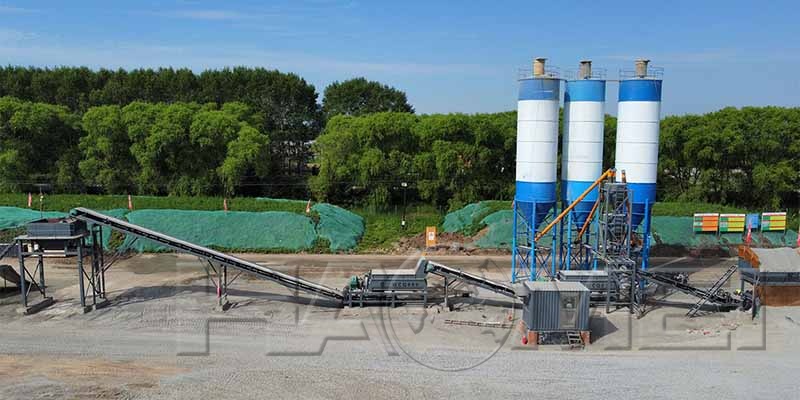
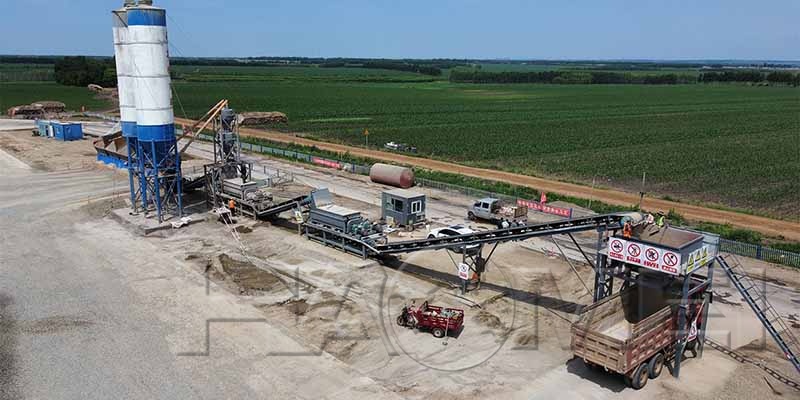
For road contractors with repeated base-layer jobs, a product package such as a Stabilized Soil Mixing Plant for Road Construction is usually easier to justify than a custom one-off plant, because spare parts, operator training, and documentation are more predictable.
Use the table below to narrow your configuration.
| Plant type | Best fit | Strengths | Watch-outs |
|---|---|---|---|
| Mobile modular plant | Short projects, frequent relocation | Faster installation, lower civil works cost | Smaller storage, more generator dependence |
| Stationary plant | Long highway, airport, industrial yard | Higher output, larger silos, better automation | Higher foundation and relocation cost |
| Continuous pugmill plant | Large-volume base course | High productivity, simple process flow | Requires tight feeder calibration |
| Batch plant | Smaller lots, frequent recipe changes | Better batch traceability | Lower throughput and more cycle time |
A practical costing method is to separate purchase price from installed operating cost. Public export quotations for new continuous soil-cement plants commonly vary by capacity, automation, silo size, dust collection, and country of manufacture. For budget screening, many 300 to 600 t/h new plants fall into a six-figure USD range before ocean freight, duties, foundations, cranes, power supply, and commissioning. Treat any online price as incomplete until the seller confirms the Incoterm, included silos, control system, installation labor, spare parts, and warranty.
Use this quotation checklist:
Quality failures are expensive because stabilized base is buried under other pavement layers. The plant must control binder percentage, moisture, gradation, and mixing time. Do not rely on visual checks alone.
| Control point | Field action | Acceptance evidence |
|---|---|---|
| Aggregate grading | Sample stockpiles and belt discharge | Sieve analysis against project limits |
| Cement or lime feed | Calibrate screw feeder and weigh usage | Daily binder consumption versus production tonnage |
| Moisture | Test incoming aggregate and mixed material | Moisture-density records from lab or field test |
| Compaction | Coordinate output with rollers | Density test results and roller pass records |
| Strength | Cast and cure specimens | ASTM or AASHTO test reports required by contract |
| Production data | Export shift reports | Time, recipe, tonnage, alarms, operator name |
Safety and compliance deserve the same attention as capacity. Cement and lime dust can contain respirable crystalline silica when aggregate handling generates dust. OSHA 29 CFR 1926.1153 sets a permissible exposure limit of 50 micrograms per cubic meter as an 8-hour time-weighted average in construction. Controls may include enclosed conveyors, silo filters, water sprays, housekeeping by vacuum, respirators when required, and worker training.
For environmental management, confirm whether the site needs a stormwater permit under the U.S. EPA National Pollutant Discharge Elimination System framework, or the equivalent local permit outside the United States. Washout water and high-pH runoff from cementitious materials should not enter drains or natural waterways. In the European market, machinery conformity should be assessed under the current Machinery Directive 2006/42/EC until the new Machinery Regulation (EU) 2023/1230 becomes applicable in 2027.
Industry trends are changing what a sound investment looks like:
Before signing, run one final commercial test. Calculate cost per finished ton using binder consumption, electricity or diesel, loader fuel, wear parts, labor, mobilization, and expected utilization. A higher-spec plant can be cheaper over a season if it saves 0.3% to 0.5% cement through accurate dosing, because cement is usually one of the largest variable costs in stabilized base production. Ask the supplier to demonstrate calibration, show a real production report, and provide references for plants of the same capacity working with similar materials.
Original source: https://www.concretebatchplanthm.com/a/stabilized-soil-mixing-station.html
Tags: Stabilized Soil Mixing Station Soil Cement Plant Stabilized Soil Mixing Plant
Prev: Concrete Batch Plant for Sale
Next: How to Choose a Reliable Asphalt Batch Mix Plant Manufacturer