CONTACT
1
Want to get quotation of concrete batching plant at once? Contact Us. Quick reply is as efficient as our equipment.
+86-15978414719

Sep 10, 2026
For small-to-medium-scale concrete construction projects, the HZS50 stationary concrete plant is the most widely used standard model. With a standard hourly output of 50 cubic meters, it is suitable for a wide range of applications, including municipal infrastructure, rural construction, small-to-medium real estate developments, and road repairs.
HZS50 concrete plants on the market generally fall into two structural categories: the hopper type and the belt-conveyor type. The core differences between them lie in key areas such as the material feeding method, site requirements, production efficiency, and operation and maintenance costs.
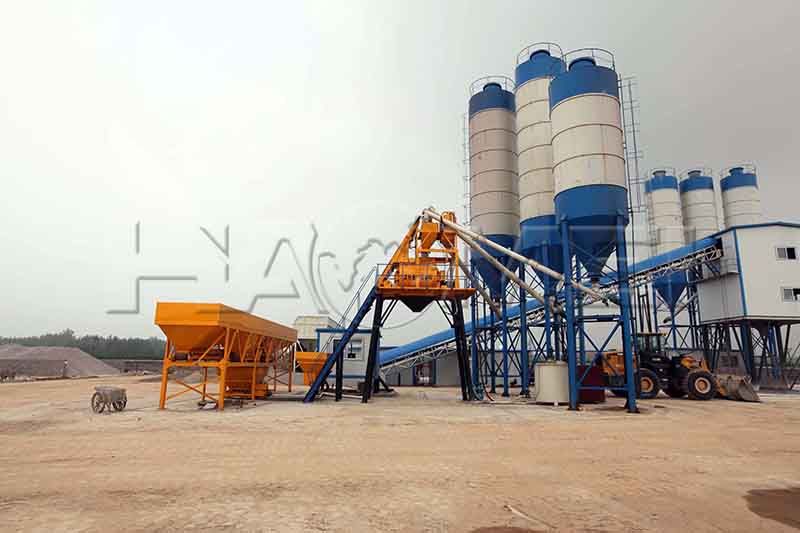
The fundamental distinction between the two types of equipment stems from their material feeding and conveying structures; this is the root cause of all performance differences.
This model utilizes a vertical skip-hoist feeding system, featuring a highly integrated and compact layout. During operation, sand and aggregate are proportioned and weighed by the batching machine before dropping into the skip hopper at the base. A winch then pulls the hopper vertically along a track to the mixer's inlet; after discharging the material, the hopper returns to its starting position to repeat the cycle. The entire unit lacks long conveyor structures, with all modules consolidated into a single, streamlined assembly.
This model employs an inclined belt conveyor structure, featuring a dual-conveyor system comprising a flat belt and an inclined belt. After precise weighing by the batching machine, aggregates are transferred from the flat belt to the inclined belt conveyor, which continuously transports them to the holding hopper above the mixer, ensuring an uninterrupted material supply. The system relies on belts for material transfer, resulting in a longer conveying path and a more extended structural footprint.
Site conditions are a primary consideration when selecting equipment. The two models differ significantly in terms of site suitability, making this a key factor in the selection process.
The greatest advantage of the HZS50 hopper concrete plant is its small footprint; compared to a belt-conveyor model of the same capacity, it saves 30%–40% of site space. It does not require extra space for an extended conveyor system, with an installation footprint of only about 8m × 12m. Furthermore, foundation construction is simple, and extensive site paving or hardening is unnecessary. It is particularly well-suited for space-constrained environments—such as cramped urban construction sites, narrow village work zones, and temporary, localized projects—effectively resolving the issue of limited space often faced by small-to-medium-sized sites.
In contrast, the belt-conveyor HZS50 belt conveyor concrete batching plant features an elongated inclined belt structure, resulting in a larger overall footprint. It also requires additional clearance for belt maintenance and material transfer, as well as stricter requirements regarding site leveling and concrete surfacing. Consequently, this model is better suited for fixed, large-scale sites with ample open space rather than temporary or cramped locations.
Regarding the standard HZS50 production capacity, there are significant differences in actual discharge efficiency and operational continuity between the two models, which directly impact project schedules.
The skip-hoist model utilizes an intermittent feeding method; the cycle of lifting, discharging, and resetting the hopper creates brief pauses between batches, preventing continuous material supply. Under standard operating conditions, the stable hourly output approaches 50 cubic meters, making it ideal for intermittent construction and low-volume pouring tasks. However, during prolonged, uninterrupted operations, the frequent starting and stopping of the hopper mechanism can lead to a slight decline in operational efficiency.
The belt-conveyor model employs continuous feeding with no operational gaps, ensuring a steady, uninterrupted flow of aggregates and boosting overall production efficiency by approximately 15%. With minimal wear from start-stop cycles and a smooth feeding rhythm, it offers superior stability during long-term continuous operation. It easily maintains a steady output of 50 cubic meters per hour, making it perfectly suited for high-volume, continuous pouring requirements.
For small-to-medium-sized construction enterprises, the total cost of ownership is a critical factor in equipment selection; the two models differ significantly in terms of initial procurement, foundation construction, and long-term operation and maintenance costs.
The skip-hoist HZS50 features a simple structure with fewer components and eliminates the need for long-distance belt conveyor assemblies, resulting in a lower purchase price. Additionally, it requires less foundation work and lower costs for site surfacing, offering excellent overall cost-effectiveness for budget-conscious small-to-medium projects and temporary sites.
Conversely, the belt-conveyor model involves a complex structure and higher-specification components, leading to a higher purchase price. When combined with the increased costs for site surfacing and foundation work, the total initial investment is significantly higher.
In skip-hoist models, key wear parts include the winch, hopper rails, and wire ropes; frequent start-stop cycles lead to wear and loosening, necessitating regular inspections and part replacements. This results in higher maintenance frequency and slightly higher long-term costs for consumables.
Belt conveyor models feature a stable structure and smooth operation without the shock of frequent starts and stops. Core components like belts and motors experience low wear and failure rates, and the system is durable and easy to maintain, resulting in lower long-term O&M costs and reduced losses from downtime.
The stability of batching and conveying in both models determines the quality and precision of the finished concrete, making them suitable for different construction quality standards.
The hopper concrete plant utilize an accumulative weighing mode; overall batching precision meets standards for general civil and municipal engineering, making them perfectly suited for applications such as rural roads, foundation bedding layers, and small structures. The equipment is compact, wind-resistant, and interference-resistant, ensuring stable operation in confined spaces.
Belt conveyor concrete batching plant typically employ independent weighing structures, offering higher precision in aggregate batching. Material transport is uniform, with no spillage or jamming issues; this results in lower batching errors and more consistent concrete quality. They meet the rigorous quality requirements of scenarios such as small-to-medium commercial concrete supply, high-standard municipal projects, and bridge auxiliary works.
Based on the differences outlined above, we can precisely identify the ideal application scenarios for each model to avoid inefficient equipment selection:
HZS50 Hopper Mixing Plant: Suitable for urban renewal in confined spaces, rural infrastructure, rural roads, bedding layers for small real estate developments, temporary construction projects, short-term rental projects, and budget-constrained small-to-medium projects. Key advantages include low cost, space efficiency, and ease of relocation.
HZS50 Belt Conveyor Mixing Plant: Suitable for fixed sites with ample space, medium-to-long-term continuous construction projects, small-to-medium commercial concrete plants, high-standard municipal projects, and large-volume continuous pouring projects. Key advantages include high efficiency, high stability, and low long-term O&M costs.
Original source: https://www.concretebatchplanthm.com/a/hzs50-hopper-concrete-plant-vs-belt-conveyor-concrete-batching-plant.html
Tags: stationary concrete plant