CONTACT
1
Want to get quotation of concrete batching plant at once? Contact Us. Quick reply is as efficient as our equipment.
+86-15978414719

Aug 14, 2026
The setup process for traditional stationary asphalt mixing plants is complex; the entire workflow—ranging from site leveling, concrete foundation pouring, and curing to the hoisting of separate equipment components, pipeline connections, and system calibration—takes at least 15 to 30 days. This not only consumes significant time but also incurs high civil engineering and labor costs. In contrast, mobile asphalt mixing plants fundamentally reconfigure the equipment structure, achieving a massive leap in installation efficiency.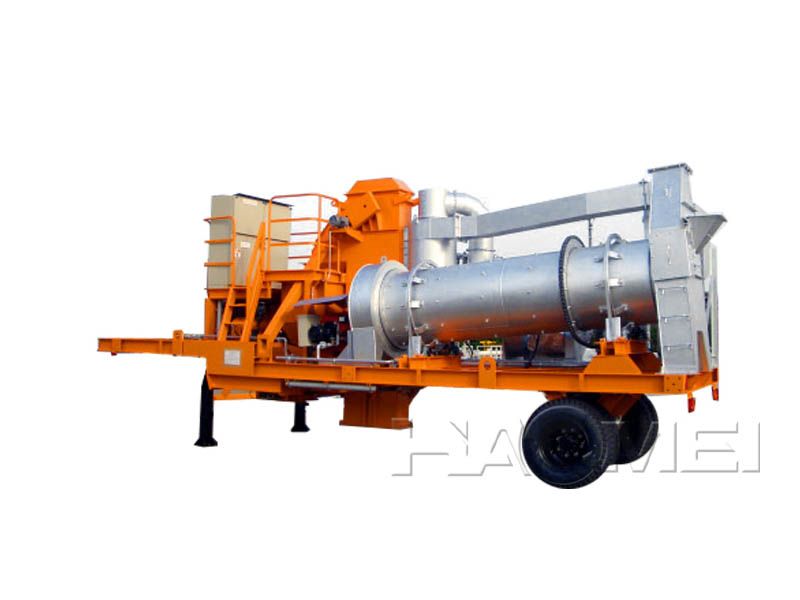
Current mainstream mobile asphalt batching plants utilize an integrated, modular design. Core components—such as the mixing unit, drying system, screening system, metering system, and electrical control system—are highly integrated into a unified containerized or trailer-mounted structure, eliminating the need for cumbersome, component-by-component assembly.
Most commissioning, wiring, and pipeline connections are completed before the equipment leaves the factory. Upon arrival at the site, no complex civil engineering is required; a solid, level hardened surface—or even compacted soil—suffices for installation, eliminating the wait time associated with concrete foundation curing.
The advantage of rapid installation is particularly evident in real-world operations. The entire system can be fully installed, commissioned, and test-run (producing output) within just 1 to 3 days using only a small crane and minimal manual assistance; large modular models can even achieve rapid commissioning within 24 hours.
Compared to stationary plants, the installation cycle is slashed by over 80%, drastically shortening project preparation times. This enables a workflow of "equipment arrival, rapid setup, and same-day production," making it perfectly suited for projects with tight schedules or temporary construction needs. Furthermore, the integrated design significantly reduces on-site wiring and pipeline connection tasks, effectively lowering the risk of installation-related faults and enhancing operational stability.
Projects such as municipal road repairs, rural road network upgrades, and phased highway maintenance often involve scattered work sites, short operational cycles, and the need for frequent relocation. Traditional stationary plants, once installed, cannot be moved and are restricted to a single site; post-project equipment idleness, dismantling losses, and the cost of re-establishing the plant elsewhere are prohibitively high.
The core competitive advantage of mobile asphalt mixing plants lies precisely in their exceptional flexibility regarding relocation and their high efficiency in moving between sites. Leveraging a mature, modular, quick-disassembly structure, the mobile asphalt mixing plant eliminates the need to dismantle core components, disconnect integrated piping, or remove electrical and drive systems; only a few auxiliary accessories need to be detached to prepare the entire unit for loading.
The assembly and disassembly process is straightforward; with a 30-ton crane and a professional crew, the entire plant can be dismantled and loaded in a single day, completely bypassing the tedious component-by-component disassembly, piping disconnection, and wiring removal required for stationary plants.
Transportation is equally efficient and convenient. Equipped with built-in towing tires and a specialized tow pin, the mobile asphalt batch mix plant can be towed by standard trucks at speeds up to 60 km/h. This eliminates the need for specialized transport vehicles or complex permits and avoids lengthy scheduling delays for short-distance transfers between job sites.
Crucially, the plant requires no recalibration or re-commissioning after relocation. Upon arrival at a new site, it can quickly resume production after simple anchoring and the reconnection of auxiliary accessories—truly achieving rapid disassembly, transport, assembly, and production.
For projects involving multiple, scattered locations, a single mobile asphalt mixing plant can serve several sites in rotation. This eliminates the need for repeated equipment purchases or site construction, preventing equipment idleness while drastically cutting costs associated with repeated civil works and installation. It significantly boosts equipment utilization rates, perfectly aligning with current trends toward lightweight, flexible construction operations.
The mobile asphalt mixing plant’s rapid installation and relocation capabilities do not come at the expense of performance; rather, they result from robust design features that balance efficiency with high performance.
Firstly, the plant utilizes an integrated manufacturing process with modular core systems that are pre-commissioned at the factory, minimizing on-site work steps from the outset.
Secondly, a foundation-free design with an optimized load-bearing structure allows for operation on various simple site surfaces, completely eliminating reliance on extensive civil engineering.
Thirdly, quick-connect piping and electrical control systems—featuring rapid plug-and-play interfaces—remove the need for specialized wiring or debugging, significantly lowering the barrier for on-site installation.
Fourthly, the wheeled towing structure features an optimized center of gravity, ensuring stable and safe transport across varying short-distance road conditions.
At the same time, while offering high efficiency and convenience, the equipment matches stationary units in terms of mixing precision, heating efficiency, and discharge quality. It comes fully equipped with eco-friendly dust removal and noise reduction systems, balancing construction efficiency with regulatory compliance without compromising the quality of the finished material or environmental standards.
Original source: https://www.concretebatchplanthm.com/a/how-fast-can-a-mobile-asphalt-plant-be-installed-and-relocated.html
Tags: mobile asphalt mixing plant
Prev: JS1500 Concrete Mixer