CONTACT
1
Want to get quotation of concrete batching plant at once? Contact Us. Quick reply is as efficient as our equipment.
+86-15978414719

Aug 21, 2026
Amidst the rapid global development of infrastructure and the continuous upgrading of construction standards, the choice of concrete production equipment directly determines project quality, construction efficiency, and environmental compliance.
In the global construction machinery sector, wet-mix concrete batching plants have comprehensively replaced traditional dry-mix plants; widely adopted for municipal projects, commercial buildings, transportation infrastructure, and precast component production, they have become the mainstream equipment for modern infrastructure.
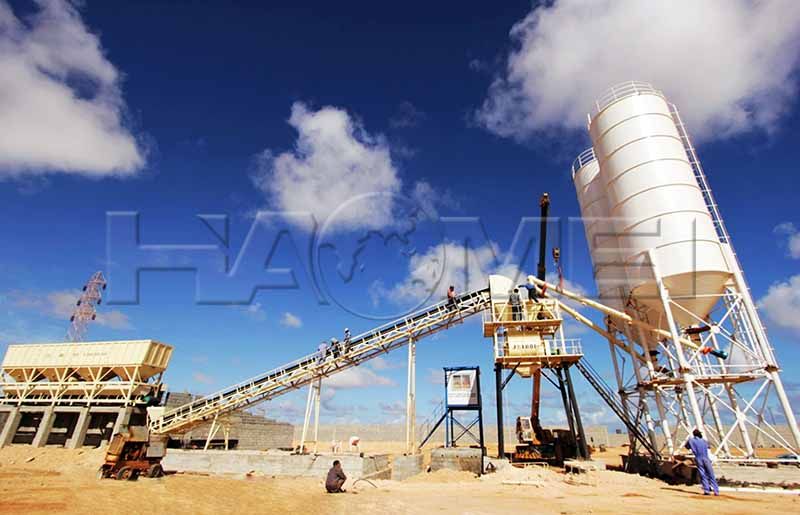
Major infrastructure projects worldwide are increasingly demanding regarding concrete strength, uniformity, and stability. Traditional dry-mix plants rely on transit mixers for in-transit mixing; the results are heavily influenced by road conditions, vehicle speed, and transport duration, often leading to issues such as uneven mixing, unbalanced water-cement ratios, and slump deviations. These inconsistencies result in fluctuating concrete quality that fails to meet the requirements of high-standard projects.
Wet-mix plants utilize an industrialized, centralized mixing model equipped with high-precision intelligent batching systems. This allows for precise control over raw material ratios and mixing times, ensuring consistent performance and stable quality across every batch. The resulting concrete offers high density, strength, and durability, making it suitable for high-specification infrastructure projects and effectively preventing the need for rework or structural safety risks—a key advantage over dry-mix equipment.
As global urbanization accelerates and large-scale infrastructure projects multiply, efficient mass production has become a core industry requirement. Dry-mix plants involve cumbersome workflows and rely on manual coordination with transit mixers; their slow discharge speeds and limited capacity often lead to supply-demand mismatches, making them ill-suited for high-volume, continuous construction scenarios.
Wet-mix plants employ fully automated assembly-line operations that integrate batching, mixing, and discharging, resulting in rapid production cycles and stable output. The finished concrete is ready for immediate pouring upon arrival—eliminating the need for secondary processing—which significantly shortens construction timelines.
Furthermore, these plants offer lower production costs per cubic meter and higher product yield rates; their long-term return on investment far exceeds that of dry-mix equipment, making them a preferred choice for commercial concrete enterprises and construction contractors alike.
Environmental regulations are tightening worldwide, with increasingly strict requirements regarding dust, noise, and wastewater emissions at construction sites. Traditional dry-mix plants often suffer from excessive dust emissions during dry material handling and lack adequate dust suppression, noise reduction, and wastewater treatment systems; consequently, they frequently face penalties, mandatory rectification orders, or work stoppages due to poor environmental compliance.
Wet-mix plants achieve green construction at the source. Through eco-friendly designs—such as enclosed mixing, water-mist dust suppression, and centralized wastewater recovery and treatment—they effectively curb dust dispersion and reduce construction noise. Their emission metrics meet global environmental standards, making them suitable for demanding locations like urban centers, residential areas, and scenic spots, perfectly aligning with the global trend toward green infrastructure development.
Dry-mix plants have significant operational limitations, making them suitable only for short-distance, small-scale, or low-specification temporary projects. In contrast, wet-mix plants offer comprehensive adaptability, meeting diverse needs ranging from mass production of ready-mixed concrete and municipal construction to large-scale infrastructure projects and precast component manufacturing.
They ensure stable operation in environments ranging from dense urban construction sites to large-scale projects in remote areas. Furthermore, the equipment is compatible with various admixtures, enabling the production of specialty concretes—such as high-strength, impermeable, and freeze-resistant varieties—to fully meet the diverse requirements of global construction projects.
Thanks to their comprehensive performance advantages, wet-mix plants have achieved widespread global adoption. Among them, the HZS60 and HZS120 models stand out as the two most widely used and best-selling flagship models, owing to their stable performance, cost-effectiveness, and high adaptability; together, they cover the full spectrum of infrastructure projects—large, medium, and small.
The HZS60 concrete batching plant is a flagship wet-mix plant designed for small-to-medium-scale projects, boasting a theoretical hourly output of 60 cubic meters. It features a compact structure, a small footprint, and simple installation and commissioning, all at an affordable investment cost. The plant is equipped with a twin-shaft forced mixer that ensures high mixing uniformity. Fully automated controls—including automatic batching and one-touch start/stop functions—effectively reduce labor costs.
It is primarily used in small-to-medium-scale projects—such as rural roads, small-scale residential developments, municipal utility networks, and minor water conservancy works—and is widely adopted in regions experiencing rapid infrastructure growth, such as Southeast Asia, Africa, and South America. It is an essential piece of equipment for small and medium-sized infrastructure projects.
The HZS120 stationary concrete batching plant is a benchmark model among medium-to-large commercial concrete plants. With a theoretical hourly output of 120 cubic meters, it features a dual-mixer synchronous mixing system and an intelligent centralized control system. It delivers stable output and high discharge efficiency, meeting the demands for continuous, large-scale concrete supply required by major projects.
The equipment offers high batching precision and mixing stability, enabling the production of various types of high-standard specialty concrete; it is well-suited for major undertakings such as expressways, high-speed railways, large-scale water conservancy projects, urban complexes, and professional commercial concrete plants.
Currently, this model holds a leading market share in high-end infrastructure projects in Europe and the Americas, major domestic projects, and large-scale infrastructure developments in the Middle East, making it a core, flagship model in the global commercial wet-mix concrete plant market.
Original source: https://www.concretebatchplanthm.com/a/why-is-wet-mix-concrete-plant-more-popular.html
Tags: stationary batching plant
Prev: How Fast Can a Mobile Asphalt Plant Be Installed and Relocated