CONTACT
1
Want to get quotation of concrete batching plant at once? Contact Us. Quick reply is as efficient as our equipment.
+86-15978414719

Apr 02, 2026
As a buyer, are you often confused by suppliers' "high capacity, low price" pitches? A new concrete plant can easily cost hundreds of thousands; choosing the wrong one not only delays construction and wastes materials but can also double future maintenance costs. Today, from a buyer's perspective, we'll break down 7 essential questions to help you avoid pitfalls, make the right choice, and tell you what a reliable solution should look like.
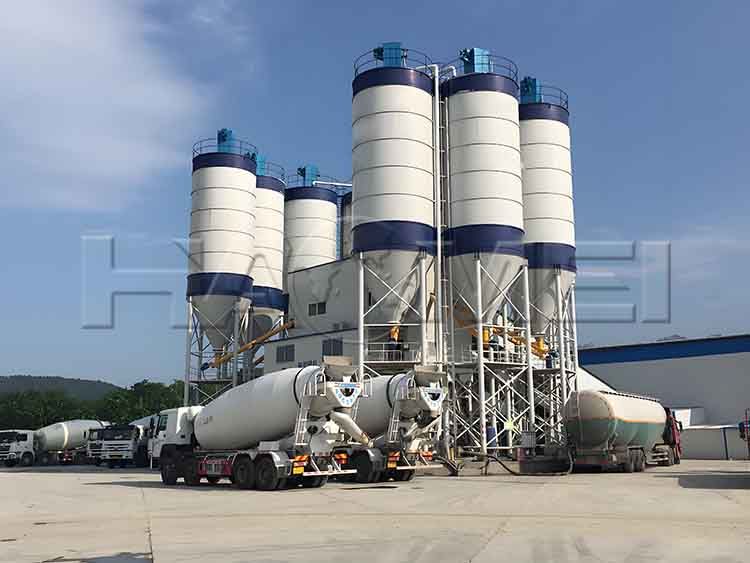
The hourly capacities of 120m³ or 180m³ are basically theoretical values—in actual operation, affected by material moisture content, equipment compatibility, and operator proficiency, achieving 80%-85% of the theoretical value is already quite good.
Judgment Criteria:
1. Obtain actual production capacity calculations from stationary RMC plant suppliers, clearly specifying the actual output under different operating conditions (such as aggregate moisture content and mixing time), rather than just theoretical parameters.
2. Request case studies of similar projects, such as "What is the actual peak capacity of a 120m³/hour plant? Will it slow down after 8 hours of continuous operation?" Use real project data to support your assessment.
Pitfalls to Avoid: Don't overkill. For example, choosing a concrete plant with a daily demand of 50m³ but an hourly capacity of 180m³ will result in 30% more electricity costs and equipment depreciation, which is a pure waste.
The lifespan of a mixing plant depends entirely on its core components—blades, reducers, PLCs, and sensors. Even a slight difference can lead to major problems.
Judgment Criteria: Request a detailed configuration list, clearly specifying the brand (e.g., SEW or Siemens for the reducer, Schneider for the PLC), model, and quantity of core components. Reject vague descriptions like "well-known brands."
Pay close attention to the material of the mixing blades/liners. They must be high-chromium alloy cast iron or wear-resistant steel plates, with a thickness ≥20mm. The shaft end seal must use a floating ring structure; otherwise, leakage and wear will occur within six months.
Avoidance Tip: Some concrete batching plant manufacturers use "generic core components + low-priced casing," which seems cheap, but the subsequent maintenance costs will be higher than the purchase price. Make sure the component brands are written into the contract.
Inaccurate batching can lead to substandard strength requiring rework, or even serious safety accidents—This is the most easily overlooked yet most fatal point for buyers.
Judgment Criteria: Suppliers must provide a metrological calibration report, clearly specifying the accuracy of the weighing sensors (within ±0.5%) and the batching fluctuation range of the screw conveyor/belt conveyor. During on-site testing, samples should be taken and tested three times: three batches of the same formula should be continuously mixed, and the concrete slump and compressive strength should be measured. A difference of ≤10% is considered acceptable to avoid mix imbalance.
Avoidance Tips: Don't believe claims that "automatic batching is accurate." Many small manufacturers' sensors lack moisture-proof and vibration-resistant treatment, causing drift with vibration, and requiring additional costs for recalibration later.
Many buyers only look at the down payment, ignoring hidden costs: energy consumption, wear parts, maintenance, and labor. These can add up to more than the purchase price.
Judgment Criteria: Obtain a full lifecycle cost estimate from the supplier: including installed capacity (energy consumption), replacement cycle and price of wear parts (blades, liners), and maintenance fees outside the warranty period;
Avoidance Tips: Beware of "low-price lure-in" tactics. Some manufacturers will repeatedly increase prices later under the guise of "parts upgrades" or "technical modifications," and should include these fees in the contract upfront.
A mixing plant operates 24 hours a day. A shutdown can result in losses of thousands of yuan per hour—the speed of after-sales response and parts supply capacity directly determine the extent of your losses. Judgment Criteria:
Clarify Warranty Scope and Period: Core components (main unit, reducer, PLC) should have a warranty of ≥3 years, and vulnerable parts (blades, seals) at least 1 year. Clearly state "Free repair for non-human-caused damage."
Confirm Parts Inventory and Response Time: Commonly used parts (blades, sensors, motors) should be in stock and shipped within 24 hours. Complex faults should be repaired on-site within 72 hours.
Inquire about Training Services: Are operation and maintenance training provided? Are there operation manuals and troubleshooting videos? This will prevent problems later on, as no one will know how to use or repair the equipment.
Avoid Pitfalls: Avoid manufacturers with "no after-sales service network," especially for remote construction sites. Waiting for maintenance personnel to arrive will delay the project.
A new rmc plant is not something you can "use immediately after purchase." Site size, power supply, and environmental requirements directly determine whether the equipment can be installed.
Judgment Criteria: Measure the site dimensions (length × width) and power capacity (e.g., 250-300kW for an HZS120 station) in advance. Have the supplier provide an installation layout drawing to confirm sufficient space for equipment, material yard, and tanker truck turning.
In urban areas or areas with strict environmental regulations, the equipment must meet dust emission standards of ≤5mg/m³ and noise levels of ≤80dB, and provide environmental certification to avoid being shut down by regulatory authorities.
For frequent site relocation, choose a modular, foundation-free mixing plant for quick installation and reusability. For long-term production, choose a fixed plant for greater stability.
Avoidance Tips: Don't overlook "foundation costs." Some manufacturers don't mention foundation construction fees and only provide a solution afterward, leading to budget overruns.
Qualifications are the bottom line, and case studies demonstrate strength—don't buy from unqualified small workshops, no matter how cheap, as quality and after-sales service are not guaranteed.
Judgment Criteria: Verify core qualifications: "Concrete Machinery Production License," "ISO9001 Quality Certification," and environmental permits. These can be verified through government regulatory platforms to avoid "three-no" equipment (equipment without proper documentation). Avoid pitfalls: Don't believe the boasts of "ten-year-old factories." Always check original qualification documents, case contracts, and even contact case clients to verify information. Avoid falling into the trap of "shell companies."
After reading these 7 questions, you should have a better understanding—a reliable solution isn't a gimmick of "low price + high configuration," but rather a precise, transparent, and implementable combination that matches your needs.
For example, if your project is a municipal engineering project with a daily demand of 80m³, limited space, and frequent relocation, a reliable solution would be as follows:
Select a mobile mixing plant with a daily capacity of 90m³ (matching production capacity and relocation requirements), using SEW reducers and Schneider PLCs as core components;
Provide a detailed configuration list and a 5-year full-cycle cost sheet, clearly specifying the price of easily damaged parts and the after-sales response time;
Provide a site layout map and environmental certifications;
Clearly define the warranty scope and training services, and promise 24-hour delivery of commonly used spare parts.
Original source: https://www.concretebatchplanthm.com/a/7-questions-you-must-answer-before-buying-concrete-batching-plant.html
Tags: stationary RMC plant
Prev: Sicoma Concrete Mixer
Next: 36 Meter Concrete Pump