CONTACT
1
Want to get quotation of concrete batching plant at once? Contact Us. Quick reply is as efficient as our equipment.
+86-15978414719

Mar 27, 2026
A global infrastructure boom is sweeping across the globe, from the Belt and Road Initiative's cross-border corridors in Asia to urbanization projects in Africa and highway renovation in the Americas. Road construction scenarios are becoming increasingly diverse, placing higher demands on the flexibility, reliability, and environmental friendliness of road construction equipment.
Among numerous asphalt mixing plants, mobile asphalt batch mix plants, with their unique technological advantages and flexibility, are gradually becoming the preferred choice for engineering teams. They are particularly suitable for decentralized construction, high-standard projects, and emergency maintenance scenarios, perfectly solving the pain points of traditional equipment's difficulty in relocation and poor adaptability, injecting new vitality into road construction projects.
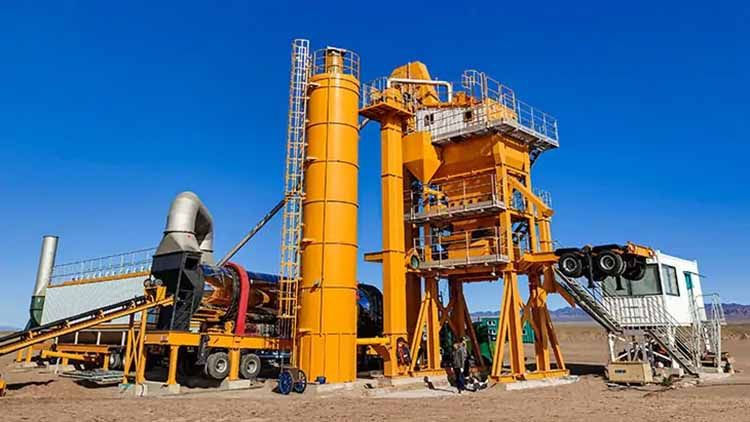
Mobile asphalt batch plants perfectly combine the two core advantages of "intermittent precision" and "mobile flexibility," becoming the optimal solution that balances quality and efficiency. Unlike continuous production drum-type equipment, intermittent mixing adopts a "batch production" mode, completing one batch every 40-45 seconds.
From aggregate weighing and heating to asphalt mixing and unloading, the entire process is controllable, with proportioning accuracy down to the gram level, strictly controlling errors within ±0.5%. This is the key reason why it can meet the stringent requirements of high-grade pavements, airport runways, and other projects. The "mobile" design breaks through the limitations of traditional fixed equipment, becoming the core competitiveness of mobile intermittent asphalt mixing plants.
Adopting a modular or semi-trailer design, it eliminates the need for complex concrete infrastructure; deployment requires only site leveling. Small equipment can be installed and commissioned in 7-10 days, while medium and large equipment can be completed in about 15 days, truly achieving "production upon delivery."
This design not only significantly reduces infrastructure costs and deployment time but also solves the challenges of cross-regional construction and relocation of scattered construction sites—core components do not need to be disassembled and can be transported directly as a whole, significantly reducing logistics costs. It is particularly suitable for projects with large spans and varied sites, such as cross-border highways in Asia and scattered construction sites in Africa.
In addition to flexibility and precision, the adaptability and environmental friendliness of mobile batch type asphalt mixing plants perfectly align with current industry development trends. In terms of adaptability, it covers a full capacity range of 40-200 t/h, allowing for flexible model selection based on project scale: small 40-90 t/h units are suitable for rural road maintenance and small to medium-sized decentralized projects, while large 60-200 t/h units can meet the needs of medium to high-standard projects such as urban main roads and airport runways.
Simultaneously, the equipment possesses strong weather resistance, operating stably in harsh environments such as -20℃ low temperatures and sandstorms, adapting to different regional climates.
In today's increasingly stringent environmental regulations, the green advantages of mobile asphalt mixing plants are becoming increasingly prominent. Equipped with a multi-stage dust collection system combining cyclone dust collectors and bag filters, dust emissions can be controlled below 30 mg/m³, far below industry standards, and some units even meet stringent environmental certifications such as the North American EPA.
From a practical application perspective, the value of mobile intermittent asphalt mixing plants has already been validated by projects worldwide. In long-distance road construction in remote areas of Libya, its rapid relocation, durability, and ease of operation perfectly meet the needs of scattered construction sites. In projects such as the Tanzanian airport expansion and the South African highway upgrade, its precise mixing capabilities ensured project quality, while its semi-trailer design solved the problem of inconvenient local logistics.
For project purchasers and managers, choosing a mobile asphalt mixing plant is essentially choosing a construction solution that is "cost-effective, efficiency-enhancing, and precisely adaptable." As an asphalt batch mix plant manufacturer, Haomei Machinery has rich models of mobile asphalt mixing plants for you to choose from.
Compared to stationary equipment, it does not require a long-term fixed site, offering greater flexibility in initial investment and a shorter return on investment period. Compared to drum-type equipment, it can meet the quality requirements of high-standard projects, supports rapid switching between multiple formulas, and adapts to more complex scenarios.
Whether it's maintenance projects requiring frequent relocation or high-standard projects with stringent quality requirements, it can achieve "local production and rapid response," effectively reducing logistics and time costs.
Original source: https://www.concretebatchplanthm.com/a/a-flexible-choice-mobile-asphalt-batch-mix-plant.html
Tags: mobile asphalt plant
Prev: Cement Silo
Next: Sicoma Concrete Mixer