CONTACT
1
Want to get quotation of concrete batching plant at once? Contact Us. Quick reply is as efficient as our equipment.
+86-15978414719

Jun 12, 2026
In infrastructure construction, precast component manufacturing, and commercial concrete mixing plants, concrete mixers are core equipment. Many people categorize counter-current mixers as a branch of planetary mixers, but in reality, the two differ significantly in structure, mixing method, suitable materials, and cost.
Counter-current Concrete Mixer: This is a horizontal drum self-fall type with an inclined drum body, resulting in a low and heavy frame. It features fixed arc-shaped blades inside the drum, without an external mixing frame, resulting in a simple structure. The inlet and outlet are located at opposite ends, and it has support legs at the bottom. This small unit can be moved by vehicle, occupying little space and facilitating maintenance and parts replacement. The single drum design eliminates complex planetary gears, giving it a distinctive appearance.
Vertical Planetary Concrete Mixer: This features a vertical, forced-drive disc structure. The machine is tall and square, with a circular flat-bottomed material tray at the bottom and a closed planetary transmission frame at the top. It has 2-3 sets of mixing arms internally, along with mixing shovels and wall scrapers, providing good sealing. The equipment is fixed and cannot be moved. Its internal components and transmission housing are complex, resulting in a prominent industrial appearance.
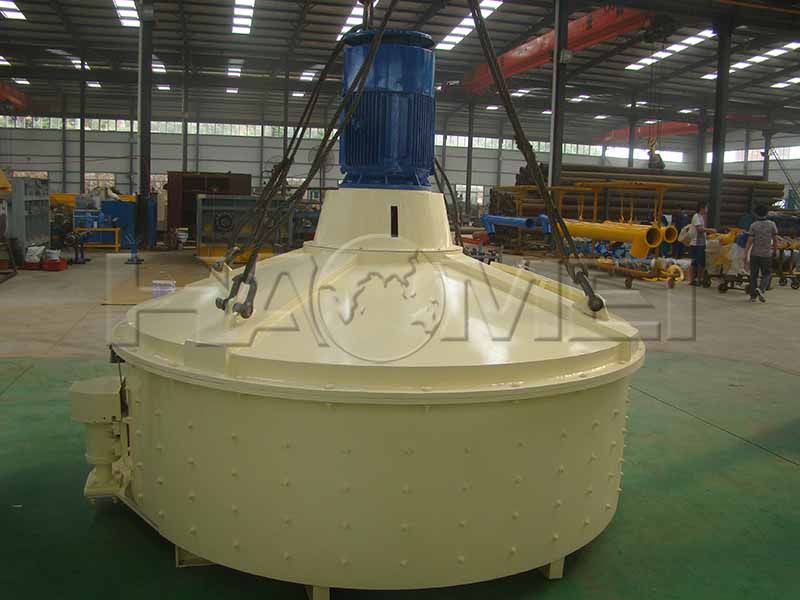
Counter-flow mixer: Relies on the bidirectional rotation of the drum to achieve gravity-feed mixing. During forward rotation, the blades lift the material, which then falls and tumbles under gravity to mix; reversing the rotation discharges the material. Material only flows vertically, without forced shearing force, making it easy for dead zones to form inside the drum. The overall transmission is simple and energy consumption is low. In the industry, a narrow definition of a counter-flow mixer specifically refers to a drum-discharge type, which is not the same as planetary counter-flow equipment.
Planetary mixer: Employs a forced mixing mode, following the principle of planetary motion. The mixing arm revolves around the frame while simultaneously rotating at high speed in the opposite direction, creating strong shearing force. Combined with the wall scraper to remove residual material from the wall, it achieves full-area mixing. The material is subjected to multiple effects of shearing, compression, convection, and kneading, resulting in uniform mixing and high mixing efficiency. The transmission components are precise and have strong load-bearing capacity.
Counter current concrete mixer: Only suitable for low-slump, conventional plastic ordinary concrete. It can mix sand and gravel aggregates up to 50mm in size and is mainly used for construction site subbases, floors, rural roads, and other ordinary projects. Unsuitable for mixing dry-hard, fibrous, permeable, self-compacting, and other high-grade and specialty concretes. These materials are prone to uneven mixing and clumping, resulting in substandard finished product quality. Suitable for temporary construction sites and small-scale outdoor infrastructure projects where homogeneity requirements are not high.
Vertical Shaft Planetary Mixer: Compatible with a wide range of materials, capable of mixing ordinary concrete and various specialty concretes, including dry-hard precast concrete, fiber-reinforced concrete, colored permeable aggregates, refractory aggregates, self-compacting high-grade concrete, and various mortars. It operates stably with fine powders, viscous materials, and fibrous aggregates, eliminating mixing dead zones, minimizing aggregate loss, and producing finished products with uniform strength and color. It is the preferred equipment for precast component plants, municipal projects, and new building material mixing.
Counter-current mixers range from $1650 to $3200 USD. They have the lowest initial cost, simple process, and interchangeable parts. Diesel models are approximately $420 USD more expensive than electric models. Overseas maintenance and spare parts costs are low, but resale value is generally average.
Vertical shaft planetary mixers are priced between $6,600 and $12,500 USD. The main costs come from precision reducers, wear-resistant components, and sealing assemblies. Custom-made explosion-proof and corrosion-resistant models can exceed $14,000 USD per unit. These machines have a long lifespan, but overseas maintenance labor and technical costs are relatively high.
The twin shaft concrete mixer is priced between $4,400 and $9,000 USD, placing them in the mid-range price bracket. Wear-resistant liners and dual motors drive up costs. Commonly used 2-cubic-meter mass-produced models overseas can reach an FOB price of $16,800 USD, making them suitable for large-scale commercial concrete plants for bulk purchasing.
Original source: https://www.concretebatchplanthm.com/a/countercurrent-concrete-mixer-vs-planetary-concrete-mixer.html
Tags: planetary concrete mixer