CONTACT
1
Want to get quotation of concrete batching plant at once? Contact Us. Quick reply is as efficient as our equipment.
+86-15978414719

Jul 03, 2026
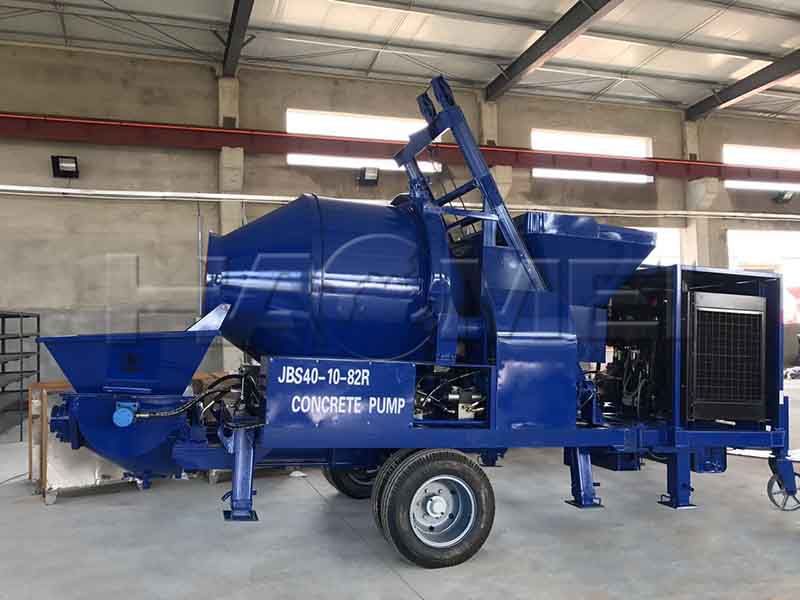
In small and medium-sized infrastructure projects, rural housing construction, flooring, and slope protection, concrete mixer pumps integrate on-site mixing and long-distance pumping, making them core construction equipment. Compared to pure delivery pumps, they have built-in mixing capabilities, eliminating the need for commercial concrete mixer trucks, resulting in greater mobility and lower costs.
However, many construction companies focus solely on price when selecting equipment, neglecting parameter matching. This can easily lead to problems such as weak pumping, pipe blockage, and difficulties in site access, resulting in project delays and increased maintenance costs. This article, combining engineering scenarios and core parameters, outlines a simplified selection method.
Prioritize clarifying the project attributes before selecting equipment to avoid overkill or underkill.
For rural self-built houses, small courtyard flooring, septic tank pouring, etc., with a daily volume <50m³ and limited space, trailer-mounted small mixing pumps are preferred, as they are compact, easy to assemble and disassemble, and offer outstanding flexibility and cost-effectiveness.
For rural roads, multi-story residential buildings, slope spraying and anchoring, etc., with a daily volume of 50-150 m³ and moderate pouring distance, a standard forced-action mixing pump is selected, offering balanced mixing and pumping performance, supporting continuous field operations.
For high-rise buildings, long-distance mountain slope protection, etc., with a daily volume >150 m³, requiring high lift and long-distance transport, a large-displacement, high-pressure mixing pump is selected. For complex scenarios, a boom structure can be used to reduce pipe laying difficulty.
Output capacity is based on hourly delivery volume as the core indicator, combined with pumping pressure reference, directly determining pouring efficiency.
Small models (20-60 m³/h): Suitable for small-volume intermittent operations, low energy consumption, and quick return on investment, used for scattered agricultural construction projects.
Medium models (60-90 m³/h): Industry-standard models, balancing efficiency and flexibility, the mainstream choice for rural construction and road projects.
Large-scale models (90-150 m³/h): High pressure and large displacement, suitable for large-area simultaneous construction, but with higher self-weight, energy consumption, and procurement costs.
Pipe blockage and insufficient feeding height are mostly caused by a mismatch between pressure and conveying distance. Elbows and flexible hoses increase conveying resistance; therefore, a margin of safety should be allowed when selecting a model.
Low-pressure models (60-80 bar): Vertical conveying ≤30m, horizontal conveying ≤200m, suitable for low-rise buildings and close-range floor pouring.
Medium-pressure models (80-160 bar): Vertical 30-60m, horizontal 200-500m, preferred for mid-rise buildings and long-distance conveying on slopes.
High-pressure models (16-32 MPa): Vertical >60m, horizontal >500m, suitable for high-rise buildings and ultra-long-distance conveying scenarios with multiple bends.
Practical Tips: A 90° bend increases the equivalent horizontal distance by 8-10m; vertical conveying reduces pumping capacity by 20%-30%, so it's recommended to add a 10%-20% pressure margin when selecting a pump.
Matching the aggregate particle size with the pipe diameter is crucial to preventing blockages.
Small Pump (100mm pipe diameter): Suitable for aggregates ≤20mm, only for fine aggregate concrete and mortar pouring.
Standard Pump (125mm pipe diameter): General specification, suitable for aggregates ≤31.5mm, meeting the needs of most civil engineering projects.
Large Diameter Pump (150mm pipe diameter): Suitable for aggregates ≤40mm, suitable for coarse aggregate concrete, dams, and other high-strength pouring.
Equipment is available in electric and diesel versions; neither is inherently superior, selection depends on the site's power supply conditions.
Electric concrete mixing pump: Low cost, low noise, low failure rate; relies on a stable three-phase power grid, suitable for long-term construction in urban areas and towns with power grids.
Diesel concrete mixer pump: No external power supply required, highly mobile; higher fuel costs; suitable for mountainous areas, remote construction sites without power grids, and temporary emergency repair projects.
Additional suggestion: For sites with unstable power supply, prioritize diesel-electric dual-fuel models to balance flexibility and economy.
Original source: https://www.concretebatchplanthm.com/a/how-to-choose-the-right-concrete-mixer-pump.html
Tags: concrete mixer pump
Prev: Soil Cement Plant
Next: Planetary Concrete Mixer