CONTACT
1
Want to get quotation of concrete batching plant at once? Contact Us. Quick reply is as efficient as our equipment.
+86-15978414719

Aug 07, 2026
In infrastructure projects, rural construction, small-scale municipal renovations, and road repairs, small concrete batch plants have become the preferred equipment for small and medium-sized construction projects due to their core advantages of small footprint, low investment cost, convenient assembly and disassembly, and controllable energy consumption. Unlike the large-scale mass production of large batching plants, small batching plants emphasize flexible adaptation and on-demand production, precisely matching the needs of small-volume, dispersed, and temporary concrete construction.
The most widely circulated, best-reputed, and most frequently used small batching plant models on the market are the HZS25 concrete batching plant and the HZS35 concrete batching plant.
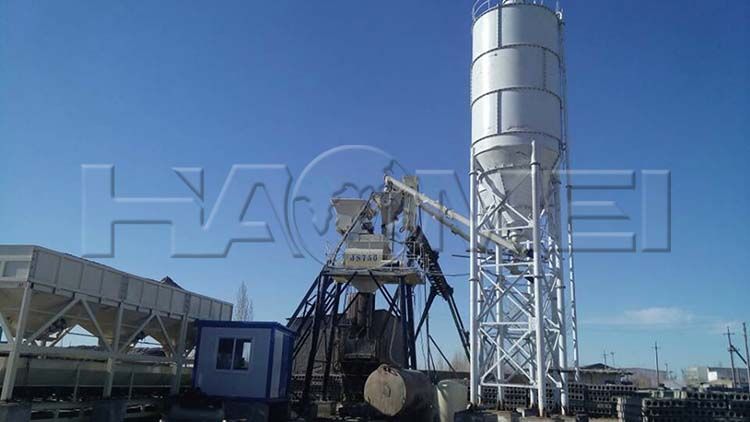
The HZS25 concrete batching plant is a basic, best-selling model among small batching plants and a benchmark model for lightweight mixing equipment. Its rated theoretical production capacity is 25 m³/h, and its actual stable production capacity can reach 20-23 m³/h. It is perfectly suited for small-volume, intermittent construction scenarios and is the core choice for rural infrastructure, scattered projects, and small repair projects.
This model adopts industry-standard supporting equipment, equipped with a JS500 twin-shaft forced mixer, ensuring excellent mixing uniformity and stable output. The single discharge capacity is 500L, and the complete mixing cycle takes approximately 72 seconds. The batching system features a PLD800 fully automatic batching machine, accurately completing the automatic proportioning of sand, gravel, cement, water, and admixtures.
Aggregate weighing accuracy is ≤±2%, and cement and water weighing accuracy is ≤±1%, fully meeting the quality standards for civil concrete construction. The entire machine has a power of approximately 42kW, low energy consumption, stable operation, and extremely low daily maintenance costs.
The biggest highlights of the HZS25 batching plant are its lightweight design, ease of construction, and low cost. The compact structure and minimal footprint eliminate the need for large hardened sites, simplifying foundation construction. Disassembly, assembly, and transportation are convenient, making it suitable for temporary outdoor construction sites.
Meanwhile, the equipment is easy to operate, supporting both fully automatic and manual dual-mode control, allowing beginners to quickly get started. It boasts a low failure rate, universal parts, and convenient maintenance. Furthermore, a heating system can be optionally added, enabling normal operation in low-temperature environments and adapting to various regional and seasonal construction scenarios.
It is primarily used for projects with small volume and short construction periods, such as rural road hardening, rural self-built houses, small irrigation canal and dam construction, municipal minor repairs, community infrastructure construction, and small-scale pile foundation projects. It is also a popular return model in the construction machinery rental industry.
The HZS35 concrete batching plant is an upgraded version of the HZS25, belonging to the high-end mainstream model among small batching plants. Its rated theoretical capacity is 35 m³/h, and the actual stable capacity can reach 30-33 m³/h. It combines the flexibility of small equipment with the efficiency of mid-range equipment, making it the optimal choice for small-to-medium-sized routine construction projects. Its market penetration rate far exceeds that of other models in the same class.
The equipment comes standard with a JS750 twin-shaft forced mixer, with a single discharge capacity of 750L and a mixing cycle of 72 seconds, significantly improving mixing efficiency. The batching system has been upgraded to a high-precision batching device, with a maximum aggregate weighing range of ≤2000kg, cement ≤700kg, and water ≤300kg.
The overall weighing accuracy is consistently within ±1%, resulting in more precise concrete proportions and more uniform finished product quality. The equipment employs quadruple sealing protection and electric oil pump technology, providing excellent sealing performance and effectively preventing dust and slurry leakage, thus enhancing operational stability.
Compared to the HZS25, the HZS35 represents a comprehensive upgrade in capacity, stability, and finished product quality, while retaining the flexibility and convenience of a small batching plant. The equipment's capacity is increased by approximately 40%, meeting the needs of continuous construction and preventing overcapacity or undersupply.
The overall dustproof and noise reduction design is more comprehensive, meeting environmental standards and complying with the environmental management requirements of small-scale construction projects in various regions. The equipment structure is reinforced and optimized, resulting in longer service life for wear-resistant parts and enhanced stability during continuous operation, making it suitable for medium- to long-term routine construction.
It is widely used in small- to medium-sized projects requiring a continuous and stable supply of concrete, such as township-level mass infrastructure construction, small- to medium-sized bridges and culverts, township road reconstruction and expansion, small precast component factories, small-scale water conservancy and hydropower projects, and factory site hardening, offering extremely high cost-effectiveness.
Many construction companies struggle with choosing between these two models. The key to selection lies in the volume of work and the construction period. Specific differences and selection guidelines are as follows:
In terms of capacity, the HZS25 produces approximately 25 cubic meters per hour, suitable for short-term, sporadic, and small-volume construction projects with lower investment costs, making it cost-effective for small projects. The HZS35 produces approximately 35 cubic meters per hour, offering higher capacity and better stability, making it suitable for medium- to long-term, continuous construction.
From a site and maintenance perspective, the HZS25 concrete plant occupies less space, is easier to assemble and disassemble, and is more adaptable to temporary sites; the HZS35 has higher equipment configuration, better environmental performance and durability, and a lower failure rate over long-term use.
From an investment return perspective, the HZS25 is more cost-effective for short-term, sporadic construction projects, while the HZS35 batching plant offers faster return on investment and wider applicability for routine small- to medium-sized construction projects.
Original source: https://www.concretebatchplanthm.com/a/what-are-popular-models-of-small-concrete-batch-plants.html
Tags: small concrete batch plant
Prev: 38m Pump Truck
Next: JS1500 Concrete Mixer