CONTACT
1
Want to get quotation of concrete batching plant at once? Contact Us. Quick reply is as efficient as our equipment.
+86-15978414719

Nov 05, 2025
The debate over whether twin-shaft or planetary concrete mixers are better when choosing an electric concrete mixer has never ceased. However, the core logic of industrial equipment is scenario compatibility: twin-shaft mixers are suitable for large-scale production, while vertical-shaft planetary mixers are suitable for high-precision production.
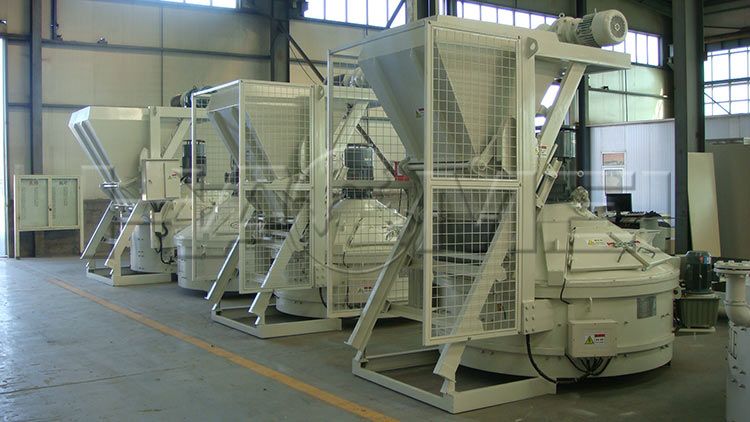
Twin-shaft mixer: It creates a triple motion of "convection + shear + vortex" through two counter-rotating mixing shafts, overcoming density differences. For fiber-containing crack-resistant mortar, its high-speed shearing at 30-50 r/min can cut and disperse the fibers, with a distribution deviation ≤5%, but a slight "inefficient zone" exists within the mixing chamber.
Planetary mixer: The mixing arms simultaneously revolve (around the central axis) and rotate (around their own axis), covering the entire mixing drum, achieving "zero dead angle" mixing. For materials with extremely high homogeneity requirements, such as UHPC (ultra-high performance concrete), the error can be controlled to ≤2%, but the rotation speed is ≤20 r/min, lacking strong shearing force. Conclusion: For ordinary mortar, a biaxial milling machine is sufficient; for precast components and special concrete production, a planetary milling machine is required.
The twin shaft concrete mixer machine adopts a "short batch + large volume" design, suitable for mass production needs: Ordinary mortar mixing time is only 20-30 seconds, and special mortar mixing time is only 30-40 seconds, while countercurrent concrete mixer’s mixing time is 60-120 seconds.
Mainstream twin shaft mixer models have an hourly capacity of 25-240 tons, and the capacity of one 5 cubic meter twin shaft mixer machine is equivalent to 5-8 planetary mixer machines. The advantage of planetary concrete mixer lies in "small batch, high precision" production, with an hourly capacity typically ≤30 tons, making them more suitable for laboratory trials or high-end niche product production scenarios.
Dual shat concrete mixer machines: The blades and liners adopt a "surface contact" design, combined with high-chromium alloy materials, resulting in a service life of 1-2 years and annual maintenance costs of only 0.5-10,000 YMB. Wear parts can be quickly replaced from the side, with downtime of only 2-4 hours.
Planetary mixer: The mixing shovel has "line contact," but the patented parallelogram blades can be rotated 180° for reuse, reducing parts costs. However, replacement requires disassembling the entire mixing chamber, taking 1-2 days.
In the mass production of ready-mixed concrete, the twin-shaft mixer is the preferred model, primarily due to its high efficiency and adaptability to continuous production lines, meeting the needs of large-scale, uninterrupted production.
For the production of precast components (such as pipe piles and PC components), the countercurrent concrete mixer is more suitable because its high homogeneity in a single mixing operation effectively reduces the scrap rate caused by uneven material mixing, ensuring the quality stability of precast components.
In the production of special mortars (containing fibers), the advantages of the twin-shaft mixer are even more pronounced. Its strong shearing force prevents fiber entanglement during mixing, ensuring uniform fiber distribution in the mortar.
For the production of materials requiring extremely high mixing precision, such as UHPC (Ultra-High Performance Concrete) or dental restorative mortar, planetary mixers are an essential choice. Their zero-dead-angle mixing characteristic ensures stable material properties, meeting high-precision production standards.
For dry-mix mortar plants, twin-shaft mixers are more suitable for production needs because of their high single-machine capacity, reducing the number of machines required and thus saving on site occupancy costs and optimizing factory layout.
Twin-shaft mixers are technologically mature and, as the main production machine for standard commercial concrete, have a significant price advantage. Planetary mixers, due to their precision structure, typically require an initial investment 2-3 times that of twin-shaft mixers; however, in the precast industry, costs can be recovered by reducing scrap rates.
Define Requirements: Firstly, clarify the production type (ready-mixed concrete / precast components / special materials) and capacity requirements (choose a twin shaft mixer for ≥200 tons per day, and a planetary mixer for ≤50 tons per day);
Calculate Costs: For mass production scenarios, prioritize calculating the "capacity-to-cost ratio," while for high-precision scenarios, focus on calculating the "quality loss cost";
Consider Compatibility: For cast-in-place concrete, a double shaft concrete mixer can be used (relying on a secondary mixing tanker), while precast production requires a countercurrent concrete mixer (no secondary mixing step).
Original source: https://www.concretebatchplanthm.com/a/what-is-the-best-electric-cement-mixer.html
Tags: planetary concrete mixer
Prev: Which Type of Hot Mix Asphalt Mixing Plant Do You Like to Choose?
Next: Container Silo: A Good Match for Mobile Concrete Plant