CONTACT
1
Want to get quotation of concrete batching plant at once? Contact Us. Quick reply is as efficient as our equipment.
+86-15978414719

May 29, 2026
In the global infrastructure industry, concrete, as the most consumed basic building material, directly impacts the overall profit margin of a project due to its procurement and production costs. For large-scale and geographically remote overseas projects such as cross-border highways, large hydropower stations, offshore wind farms, deep-mountain mining areas, and desert new city developments, concrete cost control is a core challenge that all general contractors and engineering contractors must overcome.
Currently, the mainstream concrete supply models for global engineering projects fall into two categories: the first is the most widely used traditional ready-mixed concrete, which relies on fixed commercial mixing plants for centralized mass production and delivery to the construction site via dedicated mixer trucks; the second is the rapidly emerging mobile on-site concrete model in the global infrastructure market, which relies on integrated mobile mixing equipment deployed to the work site to store raw materials, mix them on-site, and directly complete the pouring operation.
Most overseas contractors prefer ready-mixed concrete, but in large-scale, remote overseas projects, the hidden costs associated with ready-mixed concrete, such as high long-distance transportation costs, material spoilage and losses, and supply delays, are often easily overlooked.
This article will provide an in-depth comparison of two supply models from four aspects: production model principles, comprehensive cost breakdown, adaptation to construction scenarios, and long-term comprehensive benefits. This comparison aims to help overseas engineering professionals accurately match solutions and achieve cost reduction and efficiency improvement in projects.
Globally, the total cost of concrete projects mainly comprises five parts: raw material procurement costs, production and processing costs, finished product transportation and distribution costs, material scrapping and loss costs, and project-related hidden costs. Based on field tests in multiple overseas projects, the price difference in raw material procurement between the two models is less than 3%. Market pricing for sand, gravel, and cement is transparent in various regions, resulting in essentially comparable costs.
The core factors that truly differentiate construction costs and determine project profitability lie in three areas: finished product transportation costs, on-site production miscellaneous expenses, and comprehensive material loss. These are also the key breakthroughs for cost reduction in remote overseas projects.
Transportation costs are the most fundamental difference between the two concrete supply models, and also the biggest cost pain point for using ready-mixed concrete in remote overseas projects. The specific cost breakdown under different operating radii is as follows:
(1) Traditional Ready-Mixed Concrete Transportation Costs
Ready-mixed concrete must rely on dedicated mixer trucks for finished product transportation. The comprehensive transportation cost includes basic delivery fees, vehicle asset depreciation, fuel consumption, full-time driver salaries, and additional maintenance fees for complex road conditions, among other expenses. Moreover, the cost is highly sensitive to transportation distance. Based on the global infrastructure industry's general pricing standards: within a 3-5 km operating radius in the suburbs of cities, the comprehensive transportation unit price is approximately US$25-40/m³; once the transportation radius exceeds 10 km, transportation costs will increase exponentially.
In typical overseas scenarios such as Southeast Asian mountain roads, new desert cities in the Middle East, inland mining areas in Africa, and remote hydropower stations in Latin America, the distance between the construction site and the nearest commercial mixing plant generally reaches 20-50 km. For some cross-regional long-distance infrastructure projects, the transportation distance even exceeds 80 km.
Under these conditions, the comprehensive transportation cost of ready-mixed concrete can reach US$80-150/m³, accounting for 20%-35% of the overall concrete procurement cost. This high transportation cost directly compresses project profit margins.
Furthermore, most remote overseas areas only have access to winding dirt roads and simple gravel roads. Poor road conditions not only double the maintenance costs of the mixing trucks and lengthen the single transportation time, but also prevent large, heavy-duty mixing trucks from passing due to road load-bearing capacity and curve radius limitations. Only small tank equipment can be used, significantly reducing transportation efficiency and further increasing the unit cost of transporting finished products.
(2) Mobile Concrete Transportation Costs
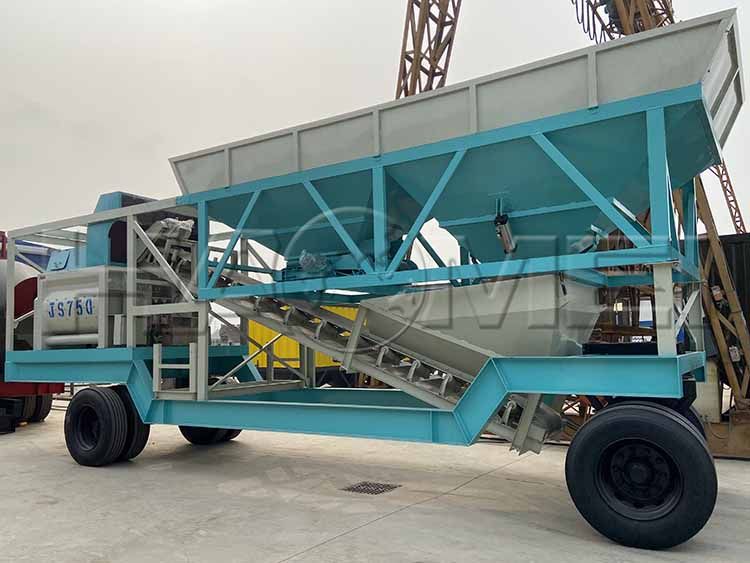
Mobile concrete completely avoids the long-distance transportation of finished products, only incurring short-distance transfer costs for basic raw materials. After the mobile concrete batch plant is installed at the construction site, raw materials such as sand, gravel, and cement can be directly transported in batches to the temporary mixing point.
Compared to finished product tanker truck transportation, raw material transshipment has two core advantages: Firstly, ordinary general-purpose freight trucks can be used instead of expensive dedicated mixing tankers, resulting in lower per-vehicle transportation rental costs; secondly, sand, gravel, and cement have no initial setting time restrictions and are not constrained by transportation time or transit road conditions, allowing for centralized bulk procurement and transportation, thus spreading out miscellaneous transportation costs per trip.
Even in large-scale projects with multi-zone simultaneous pouring requirements, finished concrete only needs to be transported a few hundred meters to the corresponding work site, with a comprehensive transshipment cost of less than $10/m³, a significant difference compared to the long-distance transportation cost of ready-mixed concrete in remote scenarios, making the cost reduction advantage very obvious.
(1) Traditional Ready-Mixed Concrete: Zero On-site Production Costs, but Includes High Service Provider Premiums
When choosing the ready-mixed concrete solution, no mixing equipment, dedicated sites, or production operators are required on the construction site, resulting in zero on-site production costs. However, all operating costs of commercial mixing plants, including equipment depreciation, plant land rent, production team salaries, site maintenance, and environmental compliance, are factored into the concrete sales price.
Meanwhile, market-oriented batching plants, with profitability as their core objective, will add a 10%-15% service profit premium to their overall production costs. This additional expense is ultimately borne entirely by the engineering contractor.
(2) Mobile Concrete: Fixed Upfront Investment, Long-Term Cost Reduction Through Scale
The portable batch plant for sale requires upfront investment in equipment rental/purchase, temporary mixing site leveling costs, and salaries for 2-3 dedicated operators and technicians—a one-time fixed investment. For large-scale, long-term overseas projects with a total concrete demand exceeding 10,000 m³, the fixed investment can be evenly distributed across each cubic meter of finished concrete, resulting in a unit production cost of only $15-25/m³. In addition, the concrete plant price from China is very competitive.
Comparing the production costs of ready-mixed concrete including service provider premiums, the mobile on-site production model can reduce the production cost per cubic meter by $30-50. The larger the project size and the longer the construction period, the lower the fixed cost amortization ratio, and the more significant the overall cost reduction effect. This model is suitable for large-scale, medium- to long-term overseas infrastructure projects.
(1) Material Scrap Loss
Ready-mixed concrete has a rigid initial setting time limit; the initial setting time for globally common grade concrete is only 2-4 hours. During long-distance transportation to remote overseas areas, factors such as high temperatures, long-distance bumpy rides, and road congestion can easily lead to problems such as premature initial setting, substandard slump, and aggregate segregation, directly causing overall material scrapping.
The industry average scrap loss rate is stable at 2%-5%. If substandard finished products are forcibly poured, it will also cause structural quality hazards, and the subsequent rework and rectification costs are difficult to predict.
Mobile concrete plant adopts a "mix and use immediately, pour immediately" production mode. After mixing, it is directly transported to the work site, eliminating the long-distance transportation link.
This avoids problems such as initial setting failure and aggregate segregation from the root, and the overall material loss rate can be controlled within 0.5%, significantly reducing raw material waste and quality rework costs.
(2) Hidden Time Costs
Overseas large-scale infrastructure projects have a tight construction pace, and penalties for breach of contract are generally high. The stability of ready-mixed concrete supply is easily affected by factors such as truck capacity scheduling, extreme weather, and sudden road malfunctions in remote areas, leading to supply delays and temporary interruptions that disrupt the overall pouring schedule.
Mobile mixing equipment, on the other hand, is independently managed by the contractor, allowing for flexible start-up and shutdown and capacity adjustments based on construction progress, ensuring construction continuity, indirectly saving on project management costs, and mitigating the risk of project delays.
- Municipal and residential construction projects in main urban areas and suburbs, with work sites within 5 kilometers of fixed commercial concrete plants and well-developed transportation networks;
- Small, scattered projects with low total concrete demand and short completion times, eliminating the need for fixed mixing equipment costs;
- Construction sites with limited space, making it impossible to plan temporary mixing areas, and lacking the basic conditions for on-site independent production.
- Remote, field infrastructure projects: offshore wind and solar power bases, inland hydropower stations, cross-border long-distance highways and railways, desert mining areas, new town development projects;
- Large-scale, long-term projects: total concrete demand ≥ 10,000 m³, continuous construction period 3 months or more;
- Overseas projects where regional commercial mixing plant resources are scarce, the operating and transportation radius exceeds 15 kilometers, and the overall transportation costs are too high;
- Specialized structural engineering projects with high requirements for concrete mix design flexibility, pouring timeliness, and supply stability.
Original source: https://www.concretebatchplanthm.com/a/cost-savings-vs-ready-mix-delivery.html
Tags: mobile concrete batch plant
Prev: Sicoma Twin Shaft Mixer Spare Parts
Next: 32 Meter Concrete Pump